Football ACL Injury Recovery Timeline from Surgery to Match Day
Biological Healing vs. Criteria-Based Timelines
A comprehensive ACL injury recovery in football typically spans 9 to 12 months across phased, criteria-based milestones—progressing from acute swelling control and terminal extension to progressive strength restoration, on-field rehabilitation, and competitive match clearance. The biggest trap in football rehabilitation is supporting the calendar as a doctor. While your calendar tracks dates, your knee tracks cellular remodeling. A structured rehabilitation program must balance biological healing with objective performance benchmarks rather than relying on time alone.
When a surgeon reconstructs your anterior cruciate ligament, they place a tendon graft that immediately begins a biological transformation termed ligamentisation. During the first 6 to 12 weeks, the graft undergoes necrosis and revascularization, rendering it biologically at its weakest point precisely when post-operative pain subsides and athletes feel deceptively confident. Full structural remodeling and collagen realignment take well over a year.
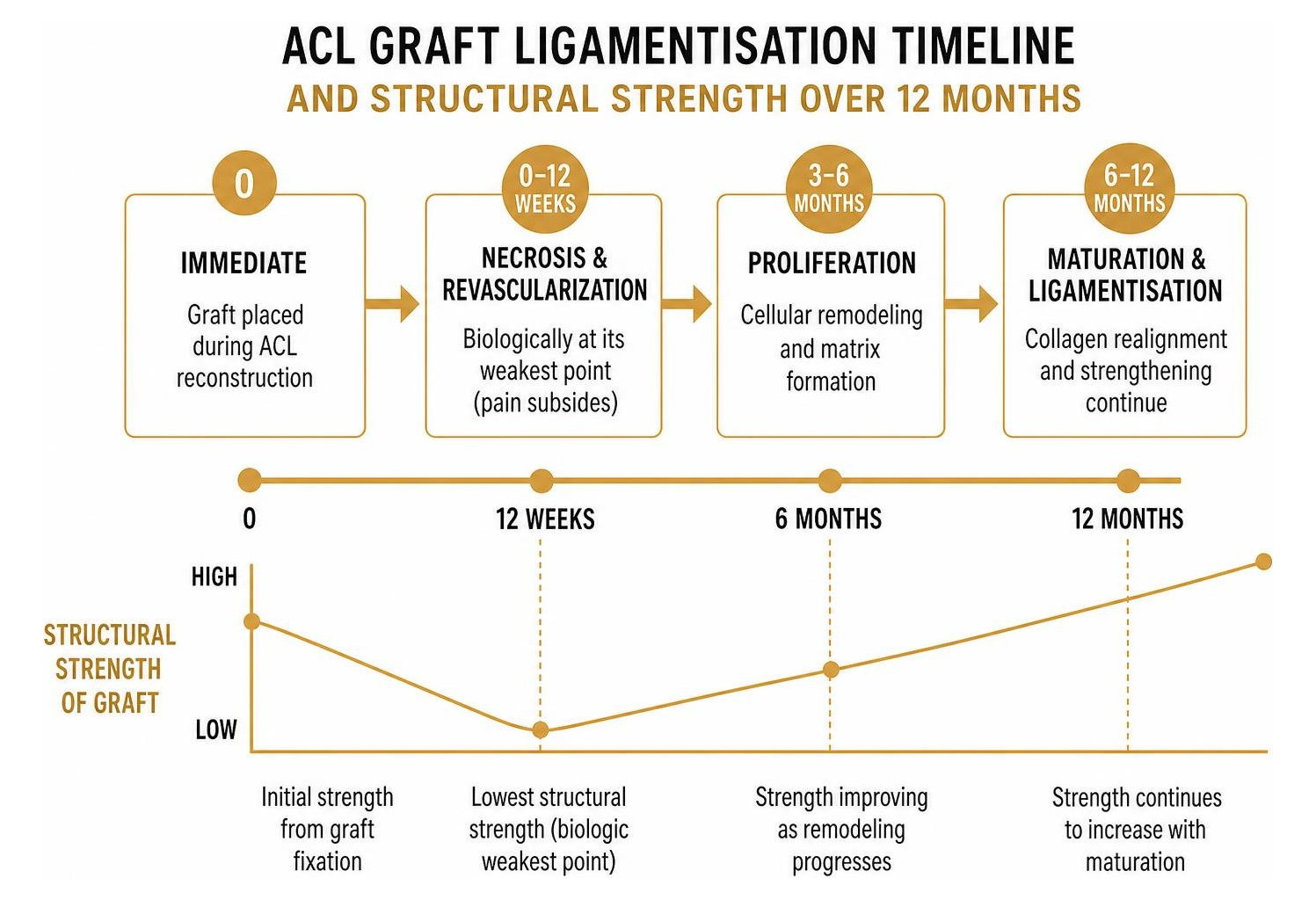
Because biology dictates the structural floor, time alone cannot guarantee functional capacity. Returning to sport based strictly on an arbitrary date leaves underlying neuromuscular deficits unaddressed. A modern systematic review on return to play after ACL reconstruction underscores that passing objective physiological benchmarks dramatically alters long-term joint health.
Data shows that delaying your return up to the 9-month mark reduces secondary tear risk by approximately 51% for every month waited. Passing rigorous physical testing alongside this biological maturation is the only way to safeguard your career.
Rehabilitation Dimension | Traditional Calendar Milestones | Modern Objective Criteria Benchmarks |
|---|---|---|
Early Progression | "Start jogging at exactly 12 weeks" | Zero joint effusion, full passive extension, and quadriceps Limb Symmetry Index (LSI) $\ge 80\%$ |
Dynamic Loading | "Begin change of direction at Month 5" | Reactive strength index targets met, symmetrical deceleration mechanics on force plates |
Return to Practice | "Rejoin team training at Month 6" | Quadriceps and hamstring LSI $\ge 90\%$, single-leg hop test battery $\ge 90\%$, ACL-RSI $> 75$ |
Match Clearance | "Cleared for competitive fixtures at Month 9" | Full sport-specific GPS load tolerance, 100% reactive agility symmetry, and match-intensity scrimmage completion |
Graft Selection and Impact on Rehabilitation
The choice of surgical graft fundamentally shapes early donor-site recovery, loading restrictions, and long-term durability on the pitch. While surgical preference varies, high-impact pivoting demands require an understanding of how each tissue heals:
Bone-Patellar Tendon-Bone (BPTB) Autograft: Frequently regarded as the gold standard for elite competitive footballers, BPTB offers rigid bone-to-bone healing within the femoral and tibial tunnels. A comprehensive clinical review on ACL tears in football (Rund et al., 2025) indicates that BPTB autografts demonstrate exceptionally low failure rates (approximately 2.0% compared to 4.1% in quadriceps tendon alternatives). However, players frequently manage anterior knee pain and donor-site kneeling discomfort during early loaded knee flexion.
Hamstring Tendon Autograft: Harvested from the semitendinosus and gracilis, this option avoids anterior knee pain but requires extended protection of isolated posterior-chain loading. Deep knee flexion hamstring strength often lags, demanding dedicated open- and closed-chain posterior-chain rehabilitation to help lower the risk of compensatory strains during sprinting.
Quadriceps Tendon Autograft: Gaining popularity due to its robust graft thickness and lower rates of anterior knee dysesthesia compared to BPTB, the quadriceps tendon graft requires targeted early interventions to overcome profound arthrogenic muscle inhibition in the extensor mechanism.
Navigating Concomitant Tears in ACL Injury Recovery Football
Isolated ACL ruptures are relatively uncommon in direct collision and heavy cutting sports; up to 89% of elite football knee injuries present with secondary joint damage. Meniscal repairs, lateral collateral ligament (LCL) ruptures, or posterolateral corner (PLC) involvement significantly alter the initial rehab arc.
When a meniscal repair accompanies your reconstruction, early weight-bearing and deep loaded flexion are restricted to protect the suture site. Similarly, an associated LCL or PLC tear requires protected bracing and restricted rotational torque for 4 to 6 weeks.
Ignoring these secondary structures invites persistent effusion, altered joint kinematics, and subsequent soft-tissue setbacks like groin or hamstring strains once field running resumes.
Five Staged Phases of ACL Injury Recovery Football Programs
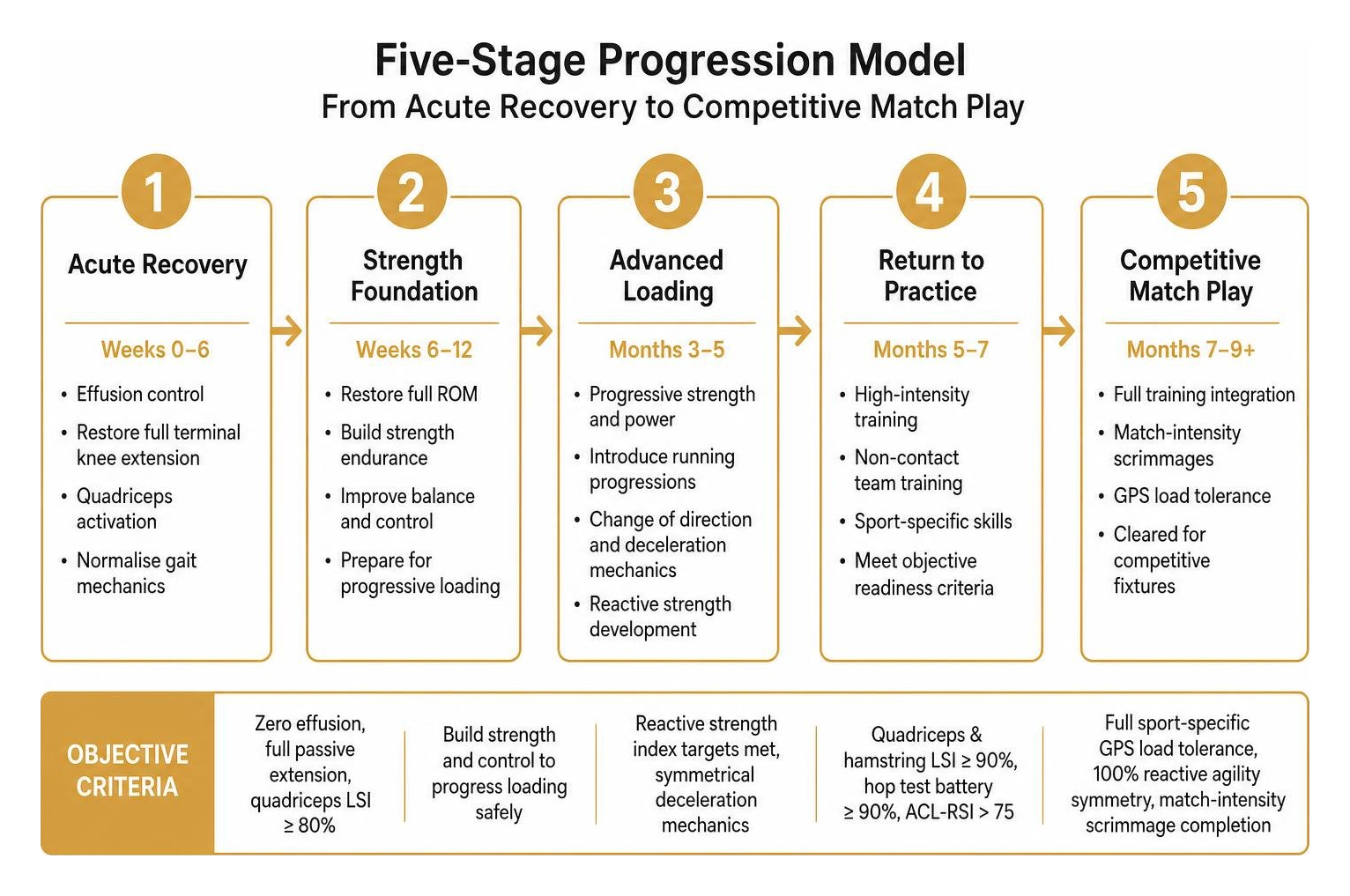
Navigating the rehabilitation journey requires structured, data-driven progression through five distinct phases. A complete ACL injury recovery football timeline typically spans 9 to 12 months from surgery to unrestricted match play, with each phase governed by objective criteria rather than calendar dates alone.
Phase 1 and 2 Milestones in ACL Injury Recovery Football
The acute recovery phase (Weeks 0–6) focuses on controlling the inflammatory cascade, waking up a dormant extensor mechanism, and achieving symmetrical terminal knee extension.
Effusion Control & Terminal Extension: Joint swelling directly shuts down the quadriceps via arthrogenic muscle inhibition. Utilizing cryotherapy, elevation, and gentle patellar mobilizations ensures full extension is restored immediately. Losing even 3 degrees of terminal extension alters gait mechanics permanently.
Neuromuscular Activation & BFR: To counteract rapid muscle atrophy without overloading healing graft tissue, we integrate neuromuscular electrical stimulation (NMES) alongside blood-flow restriction (BFR) approach. BFR simulates heavy mechanical loads using light resistance, triggering systemic muscle protein synthesis while keeping joint stress minimal.
Gait Normalization & Closed-Chain Loading: By Weeks 6–12, crutches are discarded once a symmetrical, non-antalgic gait is proven. Closed-kinetic-chain exercises—including leg presses, goblet squats, and bilateral trap-bar deadlifts—lay the foundation for absolute force development. Athletes interested in systematic physiological tracking often pair this physical foundation with our services to optimize their recovery biomarkers and tissue-healing capacity.
Advanced Strengthening, Plyometrics, and Sport-Specific Loading
As biological healing solidifies between Months 3 and 9, the emphasis pivots from general orthopedic recovery to athletic performance and chaos management.
Isolated Open-Kinetic-Chain (OKC) Integration: Modern evidence disproves the myth that seated knee extensions destroy healing grafts. Carefully introduced OKC training from 90 to 45 degrees builds isolated quadriceps hypertrophy that squats alone cannot achieve.
Force Plate Dynamometry & LSI: Progressing into ballistic hopping demands an absolute quadriceps and hamstring Limb Symmetry Index (LSI) of at least 80% to 85%, verified by handheld or isokinetic dynamometry.
Plyometric Continuum: Movement progression advances systematically from linear, planned jumps (bilateral landing $\rightarrow$ unilateral landing) to non-linear, multi-directional bounding.
On-Field Rehabilitation (OFR) & GPS Metrics: Transitioning back to the pitch requires structured on-field conditioning. Wearable GPS tracking monitors acceleration rates, high-speed running volume, and curved sprinting demands, ensuring the athlete matches match-play physical loads before entering live contact.
Psychological Readiness and Secondary Injury Risk reduction
A pristine knee on an MRI and symmetrical quad strength mean little if an athlete experiences severe kinesiophobia (fear of movement or reinjury) when planting their foot to change direction.
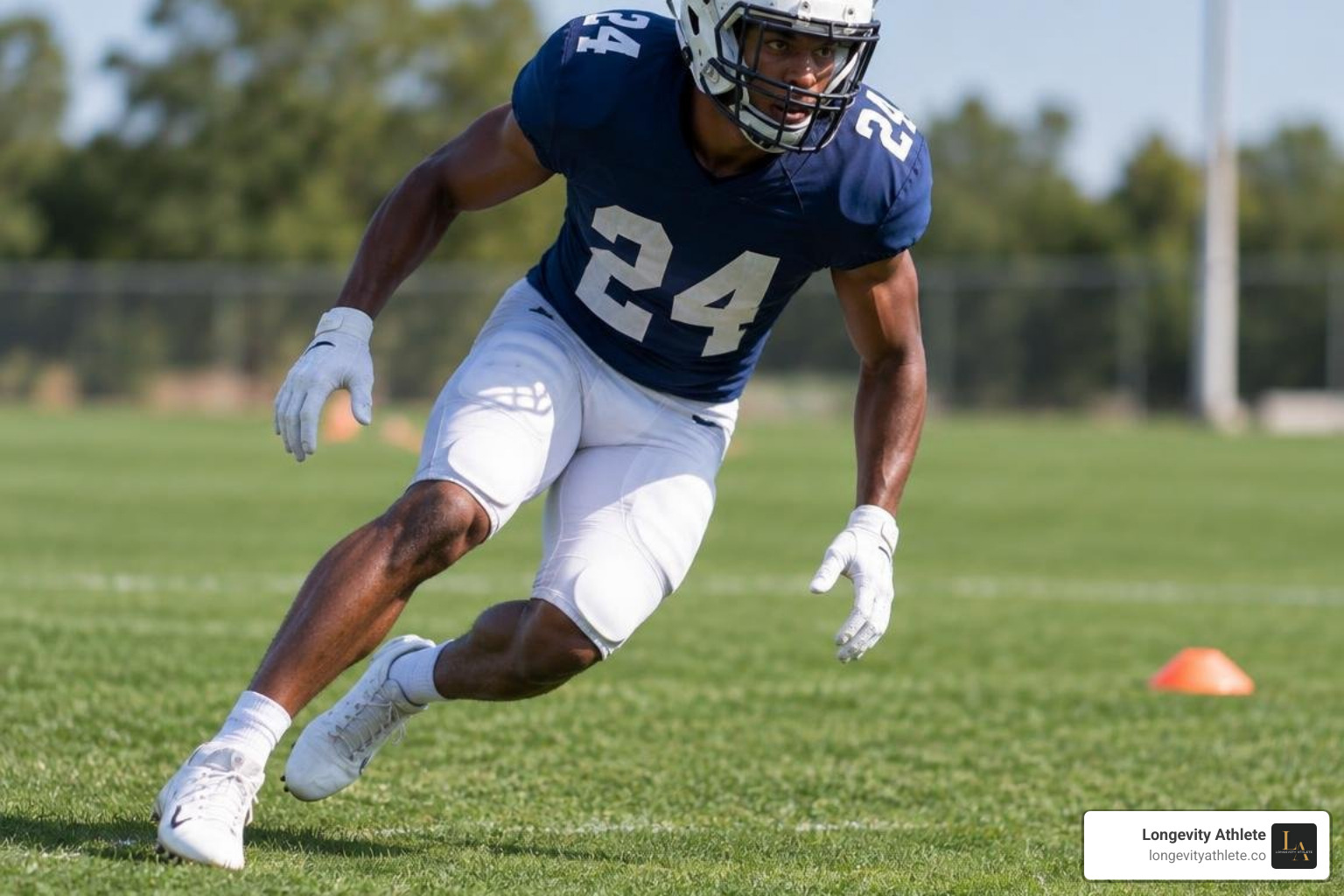
Psychological readiness frequently lags behind physical strength. Tools like the ACL-Return to Sport after Injury (ACL-RSI) scale objectively quantify an athlete's confidence, emotional stability, and risk appraisal. Athletes scoring below 75 on the ACL-RSI exhibit significantly higher rates of movement compensation, hesitating during deceleration and overloading their contralateral limb.
Bridging the gap between controlled drills and competitive chaos requires exposing the athlete to reactive, open-loop agility tasks. Defending an opponent, reacting to a visual stimulus, and tracking a loose ball retrain subconscious spinal reflexes, protecting the graft when instincts take over. For deeper insights on building physical and mental durability across athletic careers, explore our latest updates on the LA Blog.
Frequently Asked Questions About Football ACL Recovery
What is the average return-to-sport timeline for football players after ACL surgery?
In professional football cohorts, the pooled average time to return to general sports training sits at approximately 261 days (roughly 8.7 months). However, returning to full, unrestricted match play takes significantly longer, averaging 277 days (over 9 months). Factors such as concomitant meniscus surgery, graft type, and team competition level can extend this timeline to 10 to 12 months.
Why is returning before 9 months associated with higher reinjury risk?
Athletes returning to high-demand Level 1 pivoting sports prior to 9 months post-reconstruction face an approximate 7-fold higher rate of secondary ACL tears compared to those who wait 9 months or longer. Biological graft remodeling takes time, and neuromuscular fatigue resistance requires months of sport-specific loading to shield the knee during unpredictable match conditions.
How do multi-ligament injuries affect performance outcomes compared to isolated tears?
Multi-ligament knee injuries (such as combined ACL-LCL, ACL-MCL, or ACL-PCL ruptures) introduce complex joint instability and demand prolonged initial non-weight-bearing periods. Research in elite collision sports indicates that only about 18.5% of players sustaining combined ACL and posterolateral/PCL injuries return to their prior baseline performance, compared to over 90% of athletes managing isolated ACL tears.
Conclusion
Rebuilding a football player after an ACL reconstruction is a science of objective data, disciplined progression, and biological patience. Bypassing essential criteria to chase a calendar date increases reinjury risks and shortens athletic longevity. At Longevity Athlete, we bridge the gap between surgical clearance and peak match performance using personalized biomarker testing, movement analysis, and ongoing plan refinement. The Signature Plan is a self-guided group program. The Gold and Platinum Plans create individualized lifestyle plans. Take control of your athletic longevity and learn more on our home page today.
References
Rund JM, Christensen GV, Fleming JA, Wolf BR. "Anterior Cruciate Ligament Tears among Football Players.." Current reviews in musculoskeletal medicine, 2025. PMCID PMC12014870.