
Decode Your Advanced Lipid Panel for Peak Cardiac Longevity
Why an Advanced Lipid Panel Matters for Athletes
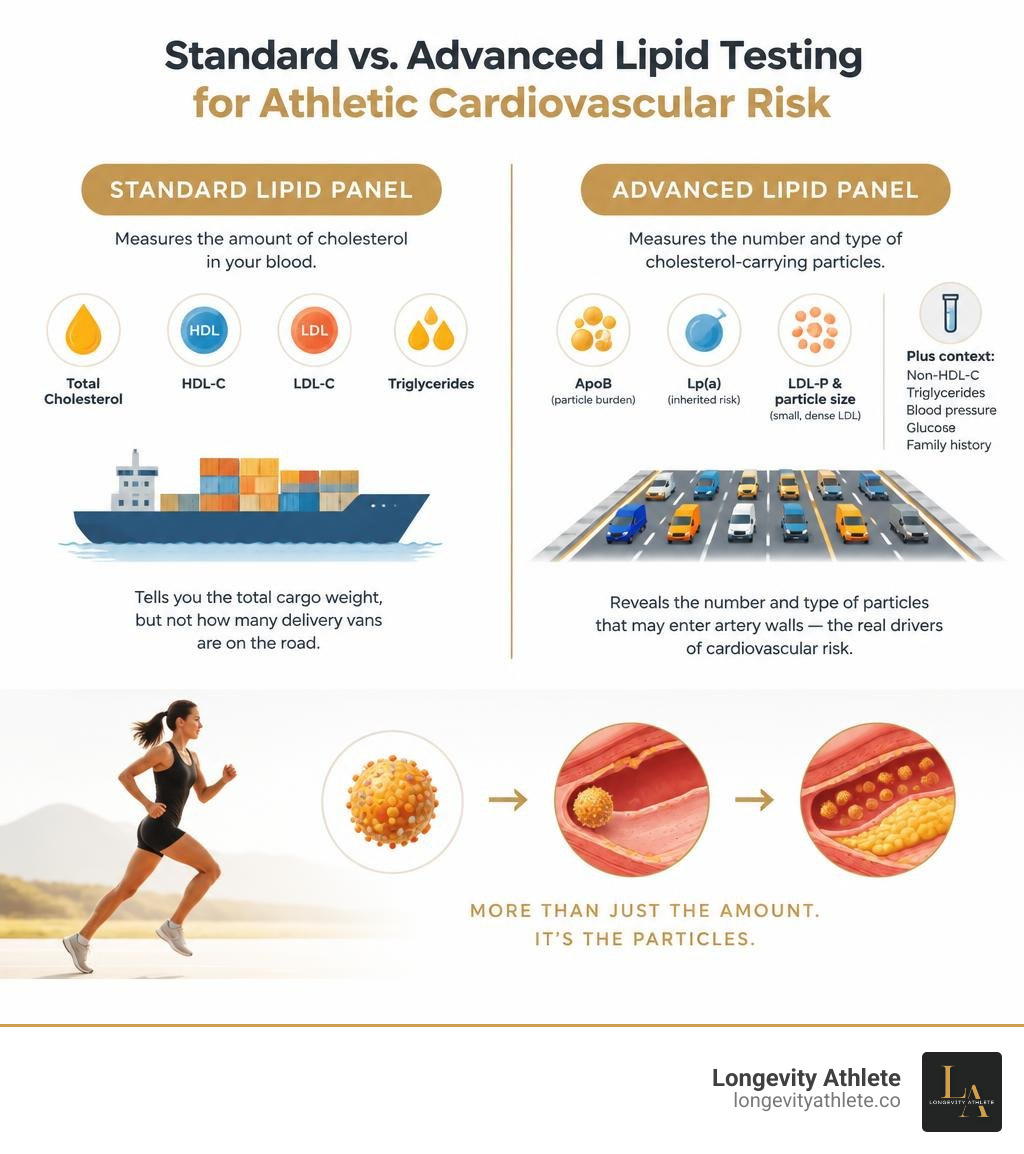
An advanced lipid panel for athletes looks beyond total cholesterol and LDL-C to estimate the number and type of cholesterol-carrying particles that may enter artery walls. It can be useful when a standard panel looks reassuring but risk is unclear, especially for middle-aged endurance athletes, athletes with a family history of early heart disease, high triglycerides, or major diet changes.
Ask a qualified clinician whether to add:
Apolipoprotein B (ApoB): a measure of atherogenic particle burden
Lipoprotein(a), or Lp(a): a largely inherited risk factor that training and diet do not reliably lower
LDL particle number (LDL-P) and particle size: markers that can reveal many small, dense LDL particles despite modest LDL-C
Non-HDL cholesterol, triglycerides, blood pressure, glucose, and family history: the context needed to interpret the results
Fitness lowers cardiovascular risk, but it does not erase genetic risk or prevent every form of atherosclerosis. In one Olympic-athlete cohort, 35.8% met the study definition of dyslipidemia. A separate case report described a 55-year-old Ironman triathlete with a low estimated 10-year ASCVD risk and only mildly elevated LDL-C, yet high LDL-P and small dense LDL after a cardiac event.
Advanced testing is not recommended as universal screening for every athlete. It is a targeted tool for finding potential blind spots, then discussing prevention with a clinician who understands both cardiovascular medicine and training demands.
The Science Behind an Advanced Lipid Panel Athletes Need for Longevity
When we review standard lipid panels, we look at the concentration of cholesterol contained inside your lipoproteins (total cholesterol, HDL-C, LDL-C, and triglycerides). Think of standard cholesterol testing like measuring the total weight of cargo arriving at a port. It tells you the bulk volume, but it tells you nothing about how many individual delivery vans are driving across your vascular highway.
An advanced lipid panel for athletes measures particle concentration and physical characteristics using nuclear magnetic resonance (NMR) spectroscopy or ion mobility fractionation. This distinction matters because plaque formation begins when individual apolipoprotein B-containing particles penetrate the arterial endothelium, become trapped in the subendothelial space, and oxidize. It is particle count—not merely the cargo weight inside them—that drives vascular damage.
Test Parameter | Standard Lipid Profile | Advanced Lipid Fractionation | Clinical Significance for Athletes |
|---|---|---|---|
LDL Measurement | LDL-C (mg/dL) — mass of cholesterol | LDL-P (nmol/L) — particle count | Identifies particle excess masked by normal cholesterol mass |
Atherogenic Burden | Non-HDL-C (calculated estimate) | Apolipoprotein B (direct count) | Direct quantification of all plaque-causing particles (VLDL, IDL, LDL) |
Genetic Risk | Not assessed | Lipoprotein(a) [Lp(a)] (nmol/L or mg/dL) | Identifies independent, genetically fixed cardiovascular risk |
Particle Size & Density | Not assessed | Small Dense LDL (sdLDL) & LDL Pattern | Identifies Pattern B phenotypes prone to endothelial penetration |
HDL Subfractions | HDL-C (mg/dL) | HDL-P & Large HDL particle count | Evaluates reverse cholesterol transport capacity under high training loads |
Beyond particle counts, evaluating targeted performance biomarkers gives us deep insight into systemic inflammation and recovery. Apolipoprotein B directly quantifies every atherogenic particle, while Lipoprotein(a) [Lp(a)] evaluates an independent, genetically determined risk factor. Because Lp(a) levels are largely driven by genetics rather than training load, identifying high levels early allows us to implement aggressive preventive strategies before vascular damage occurs.
How an Advanced Lipid Panel Athletes Receive Reveals Atherogenic Discordance
Atherogenic discordance occurs when your LDL-C (cholesterol concentration) and your LDL-P (particle number) or ApoB tell completely different stories. In high-performing competitors, we frequently observe normal or near-optimal LDL-C alongside dangerously elevated LDL-P.
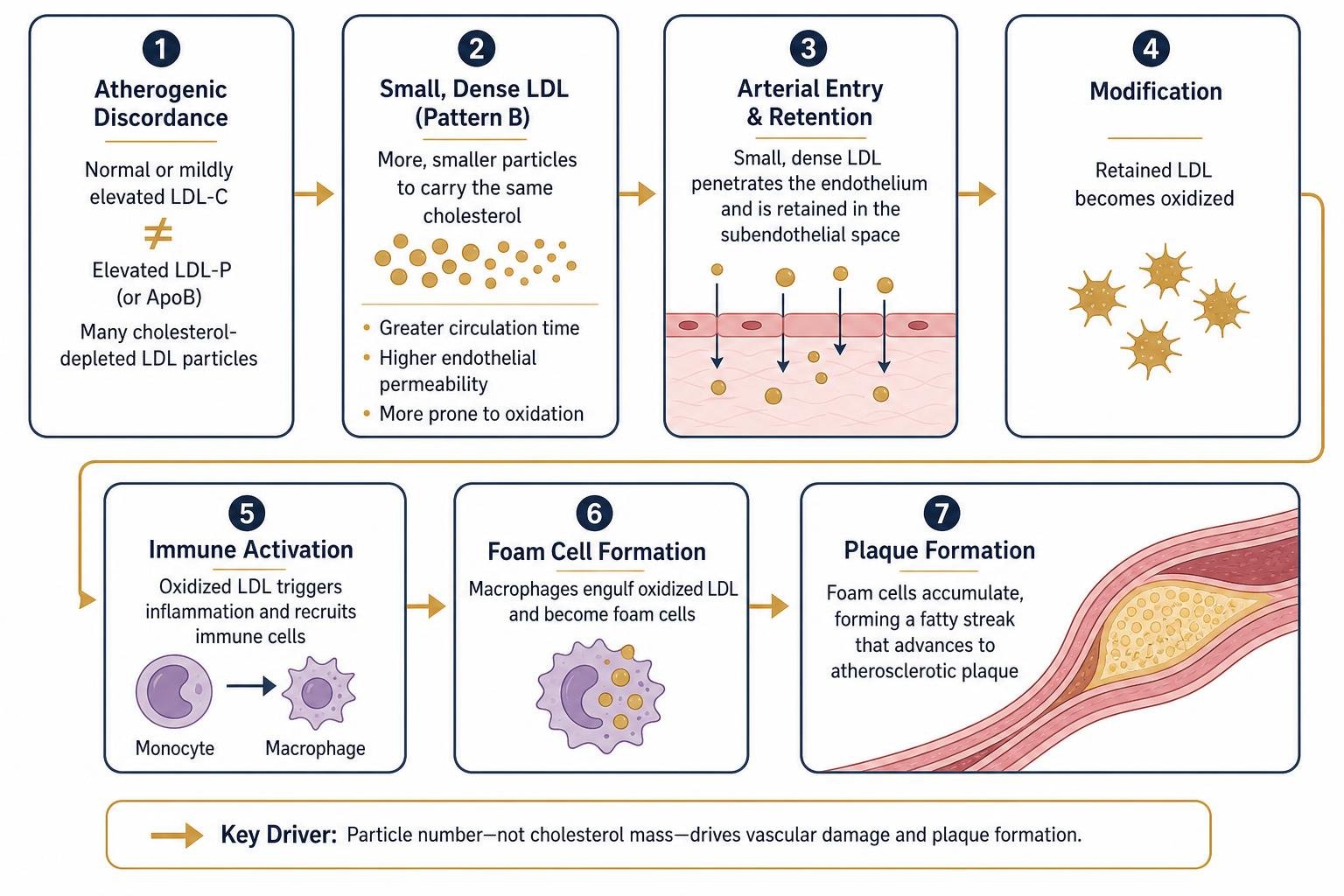
When an athlete exhibits LDL-C/LDL-P discordance, their LDL particles are cholesterol-depleted, requiring more individual particles to carry the same total volume of cholesterol. This environment produces small, dense LDL (sdLDL), termed an LDL Pattern B phenotype. Compared to large, buoyant LDL (Pattern A), small dense particles have:
Greater residence time in systemic circulation
Higher permeability across the arterial endothelial barrier
Increased susceptibility to oxidative modification
Lower binding affinity for hepatic LDL receptors, delaying clearance
As explored in this case study on advanced lipid testing in triathletes, endurance training increases muscle lipoprotein lipase activity, which dramatically lowers triglycerides. However, prolonged metabolic stress and dietary shifts can remodel lipoproteins into dense, atherogenic fractions (Mackler et al., 2026).
The 55-Year-Old Ironman Case Study: Hidden Atherosclerosis in Elite Fitness
Consider the published case report of a 55-year-old male Ironman triathlete (Mackler et al., 2026). The athlete experienced an acute myocardial infarction during the cycling leg of an endurance race, requiring field resuscitation.
Over the preceding six years, his longitudinal standard lipid panels appeared reassuring. His LDL-C fluctuated between 94 and 151 mg/dL, his triglycerides were low, and his estimated 10-year Atherosclerotic Cardiovascular Disease (ASCVD) risk was consistently calculated at under 5%. Traditional risk engines flagged him as "low risk."
Advanced lipid and inflammatory testing completed after his event revealed the hidden reality:
LDL-P: 1518 nmol/L (severely elevated; reference <1138 nmol/L)
Small Dense LDL (sdLDL): 308 nmol/L (severely elevated; reference <142 nmol/L)
Apolipoprotein B: 84 mg/dL (falsely reassuring within standard reference ranges)
High-sensitivity CRP: 1.9 mg/L (subclinical systemic vascular inflammation)
Coronary Angiography: Severe multivessel coronary artery disease
This case illustrates the hazard of relying entirely on standard cholesterol metrics and generic calculators for endurance competitors. While his ApoB was 84 mg/dL and his LDL-C was modest, his particle count was in the high-risk category, dominated by dense Pattern B particles that drove silent plaque progression (Mackler et al., 2026).
Stratifying Cardiovascular Risk in High-Performance Sports
Cardiovascular abnormalities are not restricted to masters athletes. In an evaluation of 1,058 elite competitors, dyslipidemia was the single most common cardiovascular risk factor, present in 32% of the cohort. Furthermore, in a landmark study of 957 Olympic athletes, 35.8% (343 competitors) met the diagnostic criteria for dyslipidemia based on an LDL-C ≥ 115 mg/dL or an LDL/HDL ratio ≥ 1.90.
Sport discipline heavily influences these profiles:
Endurance athletes: Exhibited the most favorable global lipid parameters, with higher HDL-C (71.6 ± 16.3 mg/dL) compared to power (62.8 ± 14.9 mg/dL), skill (61.0 ± 16.5 mg/dL), and mixed sports (66.4 ± 14.6 mg/dL).
Power and skill athletes: Displayed higher baseline triglycerides and higher total body fat percentages, correlating with increased atherogenic particle counts.
To ensure performance programs do not compromise longevity, we integrate these data points directly into our biomarker training plan guide 2026.
The Lipid Athlete Score: Major and Minor Clinical Criteria
To address the limitations of generic risk scores like SCORE or the ASCVD pooled cohort equations—which are uncalibrated for high-performance populations—researchers established the Lipid Athlete Score.
Applying this model across elite cohorts classified 1.2% as high-risk and 15.7% as medium-risk. Notably, endurance athletes were least likely to be categorized as high risk, demonstrating the vascular benefits of aerobic volume when body composition and metabolic health remain balanced. Reviewing the scientific research on the Lipid Athlete Score provides clear evidence for sport-specific screening cut-offs.
Metabolic Syndrome and Cardiometabolic Indices in Competitive Sports
Relying solely on BMI can be misleading for muscular athletes. Instead, advanced screening utilizes surrogate indices of visceral adiposity and lipid distribution: the Lipid Accumulation Product (LAP) and the Cardiometabolic Index (CMI).
Lipid Accumulation Product (LAP):
Men: LAP = (Waist Circumference [cm] - 65) × Triglycerides [mmol/L]
Women: LAP = (Waist Circumference [cm] - 58) × Triglycerides [mmol/L]
Predictive threshold for metabolic syndrome in athletes: LAP ≥ 34.66 (Hazard Ratio 7.22, p < 0.0001).
Cardiometabolic Index (CMI):
CMI = (Triglycerides / HDL-C) × (Waist Circumference / Height)
Predictive threshold in athletic screening: CMI ≥ 0.776 (Hazard Ratio 5.37, p < 0.0001).
As detailed in published evidence on cardiometabolic index evaluation in athletes, these markers identify subtle insulin resistance and visceral adiposity that standard lipid profiles miss, even when body fat appears low.
Clinical Strategy: Interpreting and Acting on Particle Profiles

Implementing an advanced lipid panel requires careful preparation. Because acute exercise alters plasma volume and lipid metabolism, we follow a standardized testing protocol:
Fasting: Fast for 12 to 14 hours prior to blood draw.
Exercise Clearance: Avoid exhaustive training bouts for 24 to 48 hours prior to sampling to normalize acute enzyme shifts.
Substance Restrictions: Refrain from alcohol, aspirin, niacin, and acute ergogenic stimulants for 24 hours.
Logistics: Typical turnaround time is 2 to 5 business days, with panel costs generally ranging from $179 to $237.
When discordance or elevated particle counts are identified, we design targeted biomarker-based nutrition plans to reduce particle numbers while fueling training demands.
Implementing an Advanced Lipid Panel: Athletes and Clinical Indications
We do not advocate for universal, indiscriminate testing across every young competitor. Instead, clinical guidelines support selective utilization for specific athlete profiles:
Middle-Aged Endurance Competitors (>35 years): Athletes engaging in high-volume marathons, ultramarathons, or triathlons.
Athletes with Discordant Profiles: Individuals with low-to-normal LDL-C paired with elevated triglycerides or low HDL-C.
Strong Familial Risk: Athletes with a first-degree family history of premature coronary heart disease or sudden cardiac events.
Low-Carb / Ketogenic Adopters: Competitors adopting low-carbohydrate, high-fat (LCHF) or ketogenic diets who experience hyper-responder spikes in total atherogenic particle counts.
Female Athletes with Energy Deficits: Athletes presenting with Relative Energy Deficiency in Sport (RED-S), where altered cortisol trajectories and endocrine suppression disturb lipid subfractions (Varga et al., 2020).
Translating Particle Numbers into Actionable Training and Dietary Protocols
Once your advanced lipid panel results are in, we focus on specific dietary and lifestyle levers:
Modulate Saturated Fatty Acids: High dietary saturated fat downregulates hepatic LDL receptor activity, prolonging LDL particle circulation. Replacing saturated fats with monounsaturated fats (extra virgin olive oil, avocado) and omega-3 polyunsaturated fatty acids reduces both ApoB and sdLDL without compromising caloric needs.
Refine Carbohydrate Quality: In athletes displaying high sdLDL and low HDL-C, excessive refined carbohydrate intake drives hepatic de novo lipogenesis. Shifting toward complex, polyphenol-rich carbohydrates improves insulin sensitivity and shifts particles toward the large, buoyant Pattern A phenotype.
Periodize Training Volume: Chronic, unrecovered endurance volume raises basal cortisol, which alters lipidomic profiles and promotes endothelial irritation (Varga et al., 2020). Balancing zone 2 aerobic sessions with adequate recovery preserves optimal lipid metabolism.
For athletes looking to optimize cardiovascular longevity, explore our comprehensive services to integrate advanced lipid metrics into your broader training strategy.
Frequently Asked Questions About Advanced Lipid Testing
What is the primary difference between LDL-C and LDL-P in athletes?
LDL-C measures the total concentration (mass) of cholesterol carried within low-density lipoproteins, expressed in milligrams per deciliter (mg/dL). LDL-P measures the absolute number of individual LDL particles per volume of blood, expressed in nanomoles per liter (nmol/L). In athletes, LDL-C can appear normal even when LDL-P is elevated, masking a high particle burden that accelerates arterial plaque deposition.
Why are standard ASCVD risk calculators inadequate for endurance athletes?
Conventional ASCVD risk tools (such as Framingham or the ACC/AHA Pooled Cohort Equations) are calibrated for general, sedentary populations over age 40. They assume that high aerobic fitness, low resting heart rate, and normal blood pressure entirely negate cardiovascular risk. However, they fail to evaluate lifelong particle burden, coronary artery calcification patterns, or genetic factors like Lp(a).
How often should high-volume athletes test their advanced lipid markers?
Athletes with optimal baseline values should retest every 12 months during a stable training block. If you have identified atherogenic discordance, elevated Lp(a), or implemented significant nutritional interventions (such as shifting macronutrient ratios), retest every 3 to 6 months to evaluate protocol effectiveness.
Conclusion
Building elite endurance while protecting long-term cardiovascular health requires looking beyond standard cholesterol numbers. By measuring particle concentration, identifying atherogenic discordance, and analyzing markers like ApoB and Lp(a), we can detect silent risks before they impact your performance or longevity.
At Longevity Athlete, our mission is to deliver actionable, data-driven protocols that bridge the gap between high performance and cardiovascular longevity. The Signature Plan is a self-guided group program. The Gold and Platinum Plans create individualized lifestyle protocols tailored to your unique biomarker profile, sport discipline, and metabolic needs.
Review our transparent pricing or learn more about the self-guided Signature Plan. Ready to take control of your cardiovascular health? Book a Call with our team today to evaluate your athletic lipid profile.
References
Mackler M, Brown S, Hu S, Alvarez D, Rocic P. "Myocardial Infarction in an Ironman Triathlete: A Case for Advanced Lipid Testing in Cardiovascular Risk Assessment.." Cureus, 2026. PMCID PMC12981363. Di Gioia G, Buzzelli L, Maestrini V, Nenna A, Monosilio S, Squeo MR, Lemme E, Pelliccia A. "Lipid Profile in Olympic Athletes: Proposal for a "Lipid Athlete Score" as a Clinical Tool to Identify High-Risk Athletes.." Journal of clinical medicine, 2023. PMCID PMC10707559. Di Gioia G, Ferrera A, Celeski M, Mistrulli R, Lemme E, Mango F, Squeo MR, Pelliccia A. "Lipid Accumulation Product and Cardiometabolic Index as Effective Tools for the Identification of Athletes at Risk for Metabolic Syndrome.." Life (Basel, Switzerland), 2024. PMCID PMC11595594. Varga TV, Ali A, Herrera JAR, Ahonen LL, Mattila IM, Al-Sari NH, Legido-Quigley C, Skouby S, Brunak S, Tornberg ÅB. "Lipidomic profiles, lipid trajectories and clinical biomarkers in female elite endurance athletes.." Scientific reports, 2020. PMCID PMC7012926.