Reclaim Your Competitive Edge Against Age-Related Performance Drops
The Physiology of Aging Athlete Performance Decline
To understand why our race splits widen and our recovery days stretch out, we have to look beneath the surface. Athletic output is an integrative physiological process. When we age, several key biological systems undergo coordinated shifts that influence our endurance, strength, and power.
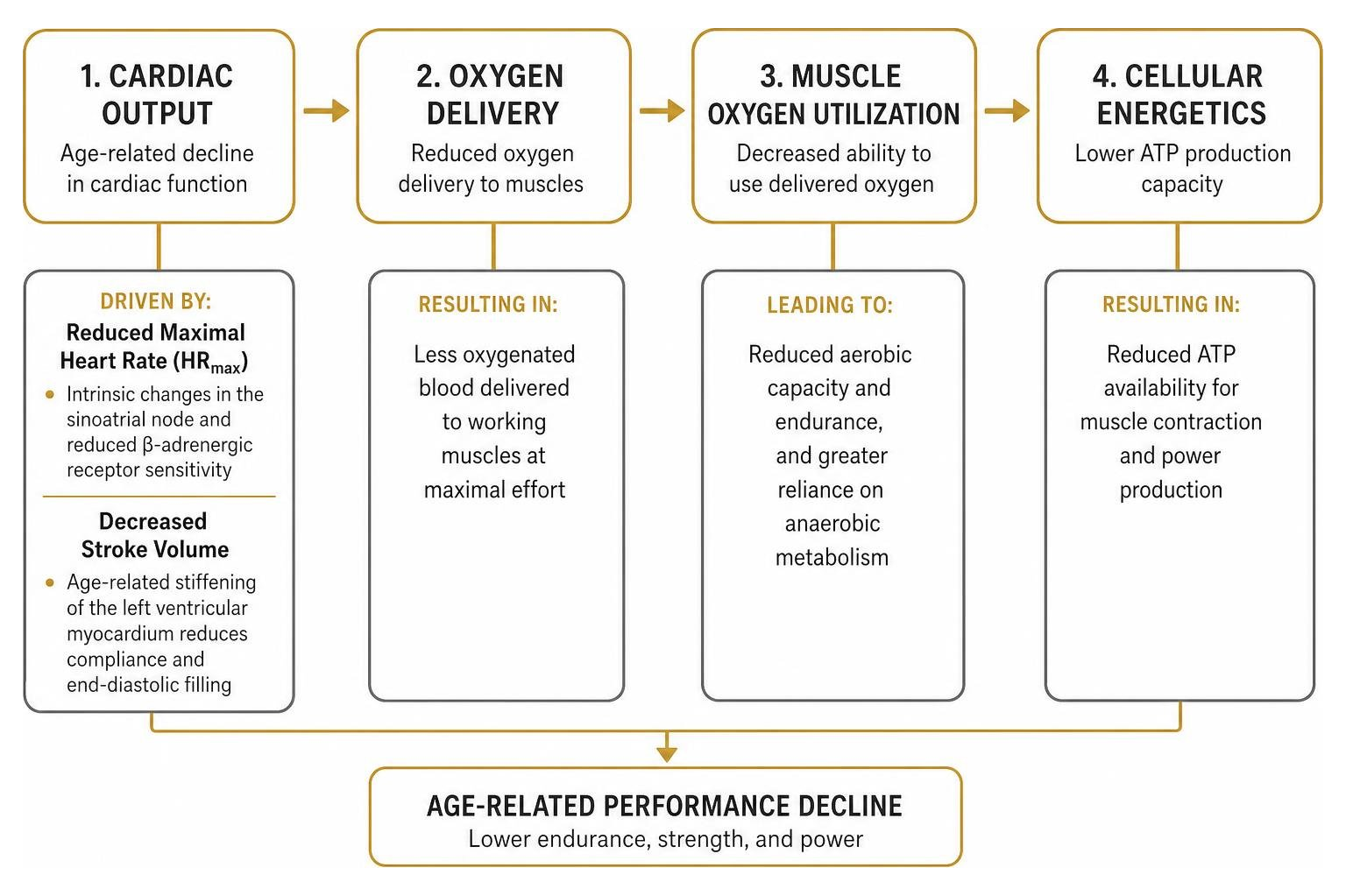
At the cardiovascular level, maximal oxygen consumption ($VO2\text{max}$) serves as the primary benchmark for aerobic potential. In the untrained population, $VO2\text{max}$ drops by roughly 10% per decade after the age of 30. This decline stems from two interconnected cardiac factors:
Reduced Maximal Heart Rate ($HR_{\max}$): Driven by intrinsic electrophysiological changes in the sinoatrial node and reduced $\beta$-adrenergic receptor sensitivity, our maximum heart rate drops predictably as we get older (roughly following the classic $220 - \text{age}$ formula).
Decreased Stroke Volume: Age-related stiffening of the left ventricular myocardium reduces compliance and end-diastolic filling, which limits the volume of oxygenated blood pumped per beat.
At the muscular level, changes in tissue structure compound these cardiovascular shifts. Sarcopenia (the age-related loss of muscle mass) and dynapenia (the loss of muscular power and strength independent of mass) begin to surface around the fifth decade. Peer-reviewed investigations into skeletal muscle structure and function in aging athletes reveal that even elite competitors experience muscle fiber denervation and atrophy around age 50 (Faulkner et al., 2008).
This structural loss disproportionately impacts fast-twitch (Type IIa and Type IIx) motor units. While Type I slow-twitch fibers show remarkable resilience, Type II fibers shrink in cross-sectional diameter and drop in total count, blunting rapid force production and peak velocity.
Simultaneously, mitochondrial energetics undergo a transition. Computational research examining muscle bioenergetics research shows that age-related fatigability traces back to alterations in maximal ATP utilization ($AUT_{\text{ref}}$) and oxidative phosphorylation activity ($k_{\text{OX}}$). As inorganic phosphate accumulates more rapidly during high-intensity efforts, our cellular engines require longer intervals to clear metabolic byproducts and restore phosphocreatine reserves.
Peak Performance Windows and Late-Career Outliers
When looking across competitive sports, the biological window for absolute peak performance is surprisingly narrow. Average peak performance ages sit around 19.97 years for male track and field athletes and 21.6 years for female track and field athletes. Power, sprint, and jump disciplines skew toward early adulthood because they rely heavily on elastic recoil, tendon stiffness, and peak neuromuscular firing rates.
Yet sport history gives us remarkable outliers who defy standard timelines:
Chris Horner: Won the 2013 Vuelta a España at age 41, conquering grueling high-altitude climbs against contenders half his age.
Dara Torres: Captured three Olympic silver medals in swimming at age 41, missing individual gold in the 50-meter freestyle by a fraction of a second.
Adam Vinatieri: Sustained elite kicking performance in the NFL deep into his 40s, competing in a sport where only two active players were over 40 in 2014.
Why do these outliers succeed? While raw aerobic ceiling ($VO_2\text{max}$) and pure fast-twitch recruitment inevitably slip, elite masters athletes often compensate through exceptional exercise economy, superior biomechanical efficiency, and decade-spanning tactical wisdom.
Sustained training buffers mitochondrial density and maintains capillarization around remaining muscle fibers, helping these athletes generate high power outputs with lower relative physiological strain.
Inherent Human Aging Versus Sedentary Inactivity
A central challenge in sports science is separating inherent biological aging from the pathology of physical inactivity. When researchers analyze sedentary cohorts, the observed decline includes disuse atrophy, metabolic dysfunction, and cardiovascular deconditioning.
To solve this, researchers developed the "set-point theory" of healthy aging (Lazarus & Harridge, 2017). This model proposes a minimum threshold of physical activity required to maintain physiological function and prevent inactivity-induced disease.
Operating at or above this set point compresses morbidity, shielding athletes from the accelerated physical decay that affects inactive populations:
Lifelong training triggers powerful cellular defenses. Landmark multi-omics studies on delayed molecular aging in exercise-trained muscle demonstrate that consistent exercise eliminates roughly 50% of the age-related gene expression gap seen in sedentary adults, restoring pathways tied to NAD⁺ biosynthesis, lipid oxidation, and cellular repair.
However, training cannot halt inherent biological aging entirely. Even the most dedicated competitors face "inflammaging"—a subtle, progressive rise in systemic low-grade inflammation. Monitoring this profile through comprehensive inflammation testing allows us to identify subclinical immune strain early, helping you adjust your training loads before chronic inflammation compromises recovery or joint integrity.
Patterns, Disciplines, and Sex Disparities in Performance Decay
Age-related athletic decline does not follow an identical curve across every discipline, distance, or sex.
Large-scale datasets analyzing master athletes establish that athletic performance follows an attenuated, roughly linear decline from age 30 up to approximately age 70. However, around the seventh to eighth decade, world-record trajectories display an inflection point where decline rates accelerate exponentially.
This late-life drop reflects an exhaustion of integrative physiological reserves across the cardiovascular, respiratory, and neuromuscular systems.
Discipline Category | Typical Peak Age Window | Post-30 Decline Rate (Per Decade) | Post-70 Trajectory Dynamics | Primary Limiting Physiological Factor |
|---|---|---|---|---|
Sprints & Short Distances | 18 – 24 Years | ~6% – 8% | Accelerated (>25% slope increase) | Fast-twitch (Type IIx) denervation & motor unit loss |
Endurance & Distance Running | 25 – 35 Years | ~10% (General) / ~5% (Trained) | Accelerated exponential increase in times | Decreased $VO2\text{max}$, $HR{\max}$, & cardiac compliance |
Throwing Events (Shot/Javelin) | 24 – 28 Years | ~3% – 5% | Linear (buffered by implement weight adjustments) | Dynamic explosive power & joint torque |
Jumping & Pole Vault | 20 – 26 Years | ~7% – 9% | Linear to moderately accelerated | Stretch-shortening cycle efficiency & tendon stiffness |
Non-Impact Endurance (Rowing/Swim) | 22 – 30 Years | ~5% | Linear across middle decades | Cardiac output (spared from ground-reaction orthopedic wear) |
Analyzing Aging Athlete Performance Decline Across Disciplines and Sexes
The rate of decline varies noticeably depending on whether an event relies primarily on aerobic capacity, anaerobic power, or specialized technical skill.
Running disciplines (sprint, middle-, and long-distance) show the sharpest acceleration in performance decay past age 70, as highlighted in comprehensive research on physical performance changes in master athletes. By contrast, throwing and jumping disciplines tend to follow a more stable, linear progression. In throwing events, some of this preservation is supported by master track governance rules that incrementally step down implement weights for older age brackets.
Sport mechanics also play a major role in overall decay rates:
Running vs. Non-Impact Sports: Road and track runners typically decline at ~1% per year after age 40 due to repetitive ground-impact forces on aging connective tissues. Rowers and swimmers experience a milder decline (~0.5% per year), as the non-impact environment protects joints and allows athletes to maintain high training volumes.
Sex-Specific Differences: While men hold higher absolute baseline marks in power and strength disciplines due to differences in lean muscle mass and androgenic hormones, this gap narrows steadily with age. In endurance disciplines, male and female performance decay curves run almost parallel once adjusted for baseline records. The steepest performance drops among men aged 30–69 emerge in the pole vault and 800m; among women, they occur in the javelin throw and 400m.
Statistical Methodologies: Longitudinal Tracking and Mixed Linear Modeling
Early exercise science often relied on cross-sectional studies—comparing a group of 30-year-olds directly against a group of 60-year-olds. However, this approach introduces significant survivor bias and cohort distortion: the 60-year-olds who remain active in master sports represent an exceptionally robust, genetically resilient subgroup.
To establish a clearer picture of human performance decay, modern researchers employ advanced statistical frameworks:
Mixed Linear Modeling (MLM): By isolating within-subject longitudinal trajectories from between-subject differences, MLM allows researchers to separate real biological aging from changes in competitive fields over time.
The Entry Cohort Model: Tracks performance based on the age an athlete entered formal competition, removing the confounding variable of cumulative training mileage and lifestyle backgrounds.
Mortality Rate Doubling Time (MRDT) Modeling: Historical studies analyzing career data from elite athletes have found that early-career metrics—such as age at peak performance and post-peak rates of decline—serve as independent predictors of late-life mortality acceleration.
Evidence-Based Strategies to Preserve Functional Output and Longevity
You cannot stop chronological time, but targeted training and physiological tracking can dramatically alter your personal rate of decline.

Modern sports science shows that preserving athletic longevity requires a multi-pillar approach:
High-Intensity Interval Training (HIIT): While long, slow distance builds an aerobic foundation, high-intensity intervals (e.g., 4x4-minute bouts at 85–95% $HR_{\max}$) provide the potent cardiac stimulus required to preserve stroke volume and slow the typical 10% per decade drop in $VO_2\text{max}$ down to roughly 5%.
Heavy Resistance and Plyometric Training: To counteract dynapenia and protect fast-twitch fibers from denervation, older athletes should incorporate resistance training at 75–85% of 1RM alongside controlled plyometrics. This preserves tendon stiffness and maintains motor unit recruitment.
Active Recovery and Sleep Architecture: As growth hormone pulsatility and tissue turnover slow, older athletes need extended recovery windows. Prioritizing slow-wave sleep and active recovery sessions keeps parasympathetic tone balanced and prevents overtraining.
Biomarker-Driven Protocols: Rather than guessing your systemic stress levels, tracking targeted performance biomarkers (such as hs-CRP, creatine kinase, testosterone-to-cortisol ratios, and ferritin) provides clear feedback to adjust your volume and prevent overreaching. Pairing this data with targeted biomarker-based nutrition plans ensures your daily micronutrient and protein intake matches the higher anabolic threshold of aging muscle.
Training Protocols to Mitigate Aging Athlete Performance Decline
Mastering training longevity requires shifting from sheer volume toward session quality and structured tissue preservation.
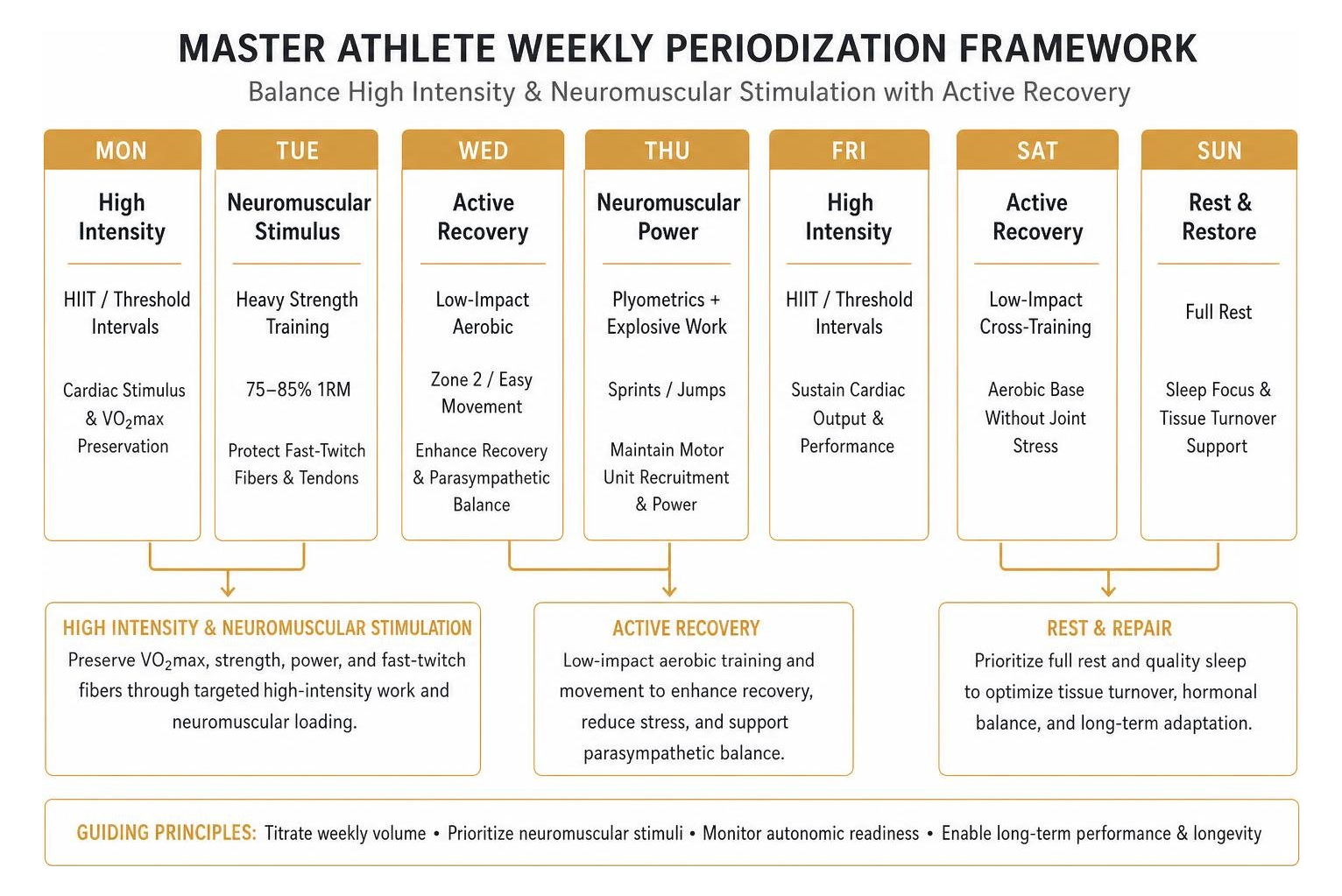
Titrate Weekly Volume: Reduce overall running or high-impact mileage by 15–25%, replacing that volume with low-impact cross-training (such as cycling or rowing) to spare articular cartilage while maintaining aerobic fitness.
Prioritize Neuromuscular Stimuli: Integrate short, explosive sprint intervals (5–10 seconds with full recovery) or heavy compound lifts twice per week to keep Type II motor pathways active.
Monitor Autonomic Readiness: Use heart rate variability (HRV) and resting pulse trends to guide daily intensity. If parasympathetic recovery indicators are suppressed, swap a planned threshold session for an easy zone-2 flush.
Follow a Structured Plan: Use our comprehensive biomarker training plan guide 2026 to systematically align your training cycles, blood chemistry updates, and recovery phases across the competitive year.
Psychological Shifts and Evolving Motivation in Master Athletes
The physical changes of aging are closely linked to psychological transitions. Young athletes are often driven by absolute performance metrics—chasing podium finishes and personal bests.
As master athletes progress into later decades, their psychological profile often shifts toward intrinsic motivation:
Mastery and Self-Efficacy: Shifting focus from all-time personal records to age-graded rankings and technical mastery preserves long-term commitment and training satisfaction.
Healthspan and Autonomy: Maintaining high physical capacity, joint mobility, and independent vitality becomes the primary driver of consistent training.
Cognitive Processing Speed: Regular participation in sports requiring rapid spatial orientation and tactical decisions preserves cognitive processing speed, helping slow the 7–10 ms per decade decline in neural processing observed in sedentary populations.
Frequently Asked Questions About Athletic Aging and Performance
Why does VO2max decline with age, and how much can training offset it?
$VO2\text{max}$ drops primarily because our maximal heart rate decreases and the left ventricle stiffens over time, reducing maximal stroke volume and total oxygen delivery. In sedentary adults, $VO2\text{max}$ declines by roughly 10% per decade after age 30.
Master athletes who maintain regular high-intensity interval training can cut this decline in half—slowing the loss to roughly 5% per decade and preserving higher aerobic capacity into their 60s and 70s.
Why do power and sprint capabilities decline faster than endurance?
Power and sprint capabilities rely heavily on fast-twitch (Type IIa and Type IIx) muscle fibers and rapid motor unit firing rates. With age, the body experiences preferential denervation and atrophy of these fast-twitch fibers, alongside a loss of elastic tendon stiffness.
Slow-twitch (Type I) oxidative fibers remain far more resilient over time, which helps athletes sustain steady-state endurance performance much longer than explosive power output.
Can master athletes maintain elite performance past age 50?
Yes. While absolute lifetime personal bests will naturally adjust, master athletes can maintain exceptional performance well past 50 by combining heavy resistance training, high-intensity aerobic work, structured recovery, and routine biomarker monitoring.
This multi-faceted approach preserves muscle mass, stabilizes hormonal health, and keeps cellular bioenergetics functioning near youthful levels.
Conclusion
Age-related athletic decline is an inescapable biological reality, but the rate at which you decline remains remarkably flexible. By understanding your cardiovascular shifts, protecting your fast-twitch muscle fibers, and matching your training volume to your body's recovery capacity, you can extend your competitive prime for decades.
At Longevity Athlete, we specialize in precision-performance wellness consulting for disciplined competitors. We move past generic training templates by using personalized biomarker testing, functional physiology panels, and data-driven protocols to optimize both your healthspan and performance.
To help you put these strategies into action, our Signature Plan offers a self-guided group program, while our Gold and Platinum Plans create individualized lifestyle protocols built around your distinct biological profile.
Ready to take control of your athletic longevity? Learn more about our specialized services, review our pricing options, or book a call with our team today.
Reference List
Lazarus NR, Harridge SDR. "Declining performance of master athletes: silhouettes of the trajectory of healthy human ageing?." The Journal of physiology, 2017. PMCID PMC5407960. Faulkner JA, Davis CS, Mendias CL, Brooks SV. "The aging of elite male athletes: age-related changes in performance and skeletal muscle structure and function.." Clinical journal of sport medicine : official journal of the Canadian Academy of Sport Medicine, 2008. PMCID PMC3928819.