
Boost Your Post-Workout Repair by Mastering Key Recovery Blood Markers
The Core Science of Athlete Recovery Biomarkers: Remodeling vs. Overreaching
Tracking key athlete recovery biomarkers—such as creatine kinase (CK), high-sensitivity C-reactive protein (hs-CRP), interleukin-6 (IL-6), and the testosterone-to-cortisol (T:C) ratio—helps you optimize post-workout repair by distinguishing productive muscle remodeling from chronic overreaching, so you can adjust training load before performance drops.
When we train hard, we intentionally disrupt cellular homeostasis. High-tension contractions and heavy metabolic demands trigger mechanical strain, micro-tears in muscle fibers, and energy depletion. In a healthy adaptation cycle, this acute stress triggers cellular repair pathways, mitochondrial biogenesis, and muscle protein synthesis—the foundational process known as supercompensation.
However, the line between productive adaptation and chronic breakdown is razor-thin. Tracking physiological changes across the Recovery-Overload Continuum allows us to differentiate between three distinct states:
Functional Overreaching (FOR): Short-term performance decrements that rebound into supercompensation after adequate rest.
Non-Functional Overreaching (NFOR): Stagnant or dropping performance lasting weeks to months, accompanied by hormonal, immune, and psychological distress.
Overtraining Syndrome (OTS): Severe, multisystem exhaustion requiring months of clinical intervention.
Relying solely on a single blood metric is like trying to judge a marathon by looking at one runner’s shoe. To truly understand our internal strain, we need to track biological signals across multiple physiological layers.
Distinguishing Productive Adaptation from Chronic Maladaptation
Exercise-induced muscle damage (EIMD) produces a temporary inflammatory cascade. Neutrophils and macrophages infiltrate damaged myofibrils, clearing debris and releasing signaling molecules that initiate repair. This transient inflammatory response is productive.
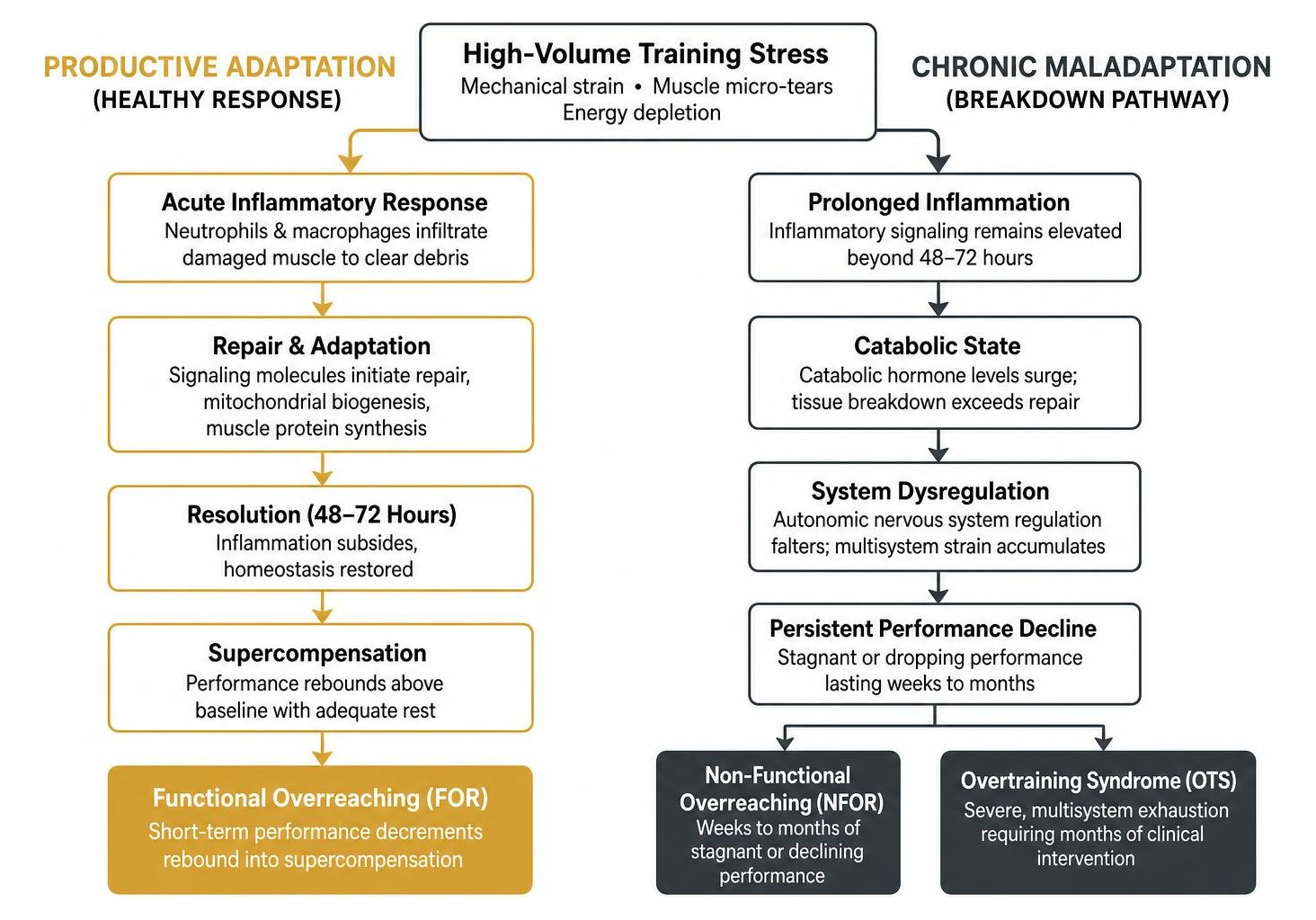
When training volume outpaces recovery capacity, this targeted repair breaks down. Instead of resolving within 48 to 72 hours, inflammatory signaling stays elevated, catabolic hormone levels surge, and autonomic nervous system regulation falters. By tracking validated performance biomarkers, we can spot this shift before functional performance drops.
The Multi-Layered Recovery-Stress Response
Biological recovery is not a single switch; it is a synchronized sequence across muscular, immune, endocrine, and metabolic systems. In elite sports, understanding the recovery-stress response of blood-based biomarkers helps coaches and sports medicine professionals calibrate training microcycles. When biological markers remain dysregulated heading into the next high-intensity block, systemic fatigue accumulates, multiplying injury risk.
Key Musculoskeletal, Inflammatory, and Endocrine Markers
To manage training loads effectively, we monitor a core panel of classic blood markers, each with distinct kinetic windows and biological interpretations:
Biomarker | Primary Physiological Domain | Peak Window Post-Exercise | Normal Clearance Timeline | Key Recovery Interpretation |
|---|---|---|---|---|
Creatine Kinase (CK) | Sarcolemmal integrity / Muscle damage | 24–48 hours | 48–72+ hours | Quantifies mechanical muscle disruption and eccentric strain. |
Lactate Dehydrogenase (LDH) | Metabolic stress / Cellular turnover | Immediate to 24 hours | 24–48 hours | Highlights acute metabolic strain and general tissue breakdown. |
High-Sensitivity CRP (hs-CRP) | Hepatic acute-phase systemic inflammation | 24 hours | 48 hours | Confirms systemic inflammatory load and tissue trauma resolution. |
Interleukin-6 (IL-6) | Myokine / Pro- and anti-inflammatory signaling | Immediate post-session | 12–24 hours | Energy sensor during exercise; mediator of systemic recovery cascades. |
Testosterone-to-Cortisol (T:C) Ratio | Anabolic / Catabolic endocrine balance | 24–48 hours | 48–72 hours | Assesses neuroendocrine strain and systemic adaptation capacity. |
Uric Acid | Purine nucleotide degradation / Oxidative stress | 24–48 hours | 48–72 hours | Reflects cellular metabolic strain and reactive oxygen species management. |
As demonstrated in match-play monitoring, post-match recovery dynamics show that while metabolic enzymes like LDH spike immediately, markers of deep structural damage such as CK often peak up to 48 hours later.
Primary Blood Markers for Muscular Damage and Systemic Inflammation
A standard creatine kinase blood test remains the clinical gold standard for assessing structural muscle stress. When muscle fibers experience microtrauma, intracellular enzymes leak through the compromised sarcolemma into the bloodstream.
However, enzyme leakage must be interpreted alongside inflammation blood markers. During acute muscular stress, Interleukin-6 (IL-6) acts as an energy-sensing myokine, stimulating the liver to produce high-sensitivity C-reactive protein (hs-CRP). In non-recovered athletes, cytokines like Interleukin-17A (IL-17A) and IL-6 remain elevated alongside elevated baseline CK levels. Regular inflammation testing ensures that acute post-workout repair does not turn into chronic, low-grade systemic inflammation.
Emerging Non-Invasive Athlete Recovery Biomarkers in Saliva and Urine
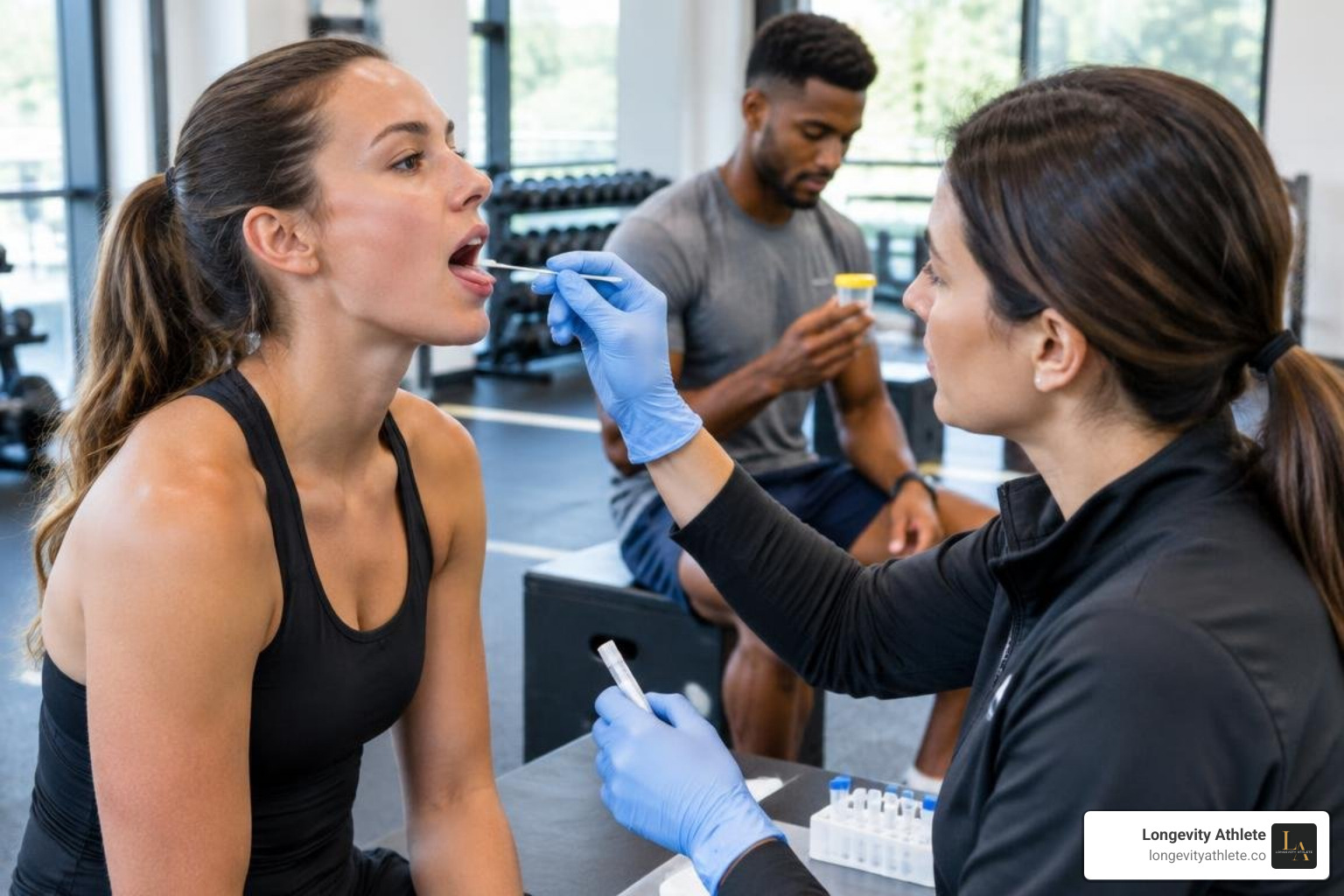
While blood testing provides deep clinical insight, drawing blood daily or mid-week is not always practical. Fortunately, emerging non-invasive matrices provide rapid, low-friction monitoring options.
Urinary N-Terminal Titin Fragments (UTF): Titin is the giant structural protein responsible for passive elasticity in sarcomeres. Eccentric exercise breaks titin down, shedding fragments into urine. A key urinary N-terminal titin fragment study revealed that UTF spikes significantly at 48 hours post-exercise across both male and female athletes, correlating strongly with drops in neuromuscular force production (rs = -0.77).
Circulating Cell-Free DNA (cfDNA): Released during cell turnover and neutrophil extracellular trap formation, cfDNA spikes within minutes to hours after exhaustive bouts, offering high sensitivity for immediate load quantification.
Targeted Saliva Multi-Omics: Recent saliva multi-omics stress profiling research demonstrates that tracking proteins (such as cystatin-C), metabolites, and lipids in saliva captures acute and delayed exercise stress. Machine-learning models can process these saliva profiles into a unified "Internal Strain Metric" (ISM), accurately distinguishing recovered states from active stress profiles.
Contextual Modifiers: Hormones, Circadian Rhythms, and the Exposome
Biomarkers do not exist in a vacuum. Interpreting recovery data requires accounting for chronobiology, hormonal status, and broader environmental exposures.

Cortisol, testosterone, and many inflammatory cytokines follow strict diurnal rhythms. Cortisol naturally peaks shortly after waking (the cortisol awakening response) and falls toward midnight. Testing blood or saliva at varying times of day introduces noise that can mask real training adaptations. Standardizing collections to a fasted, morning window is essential.
Energy Availability, Sex Hormones, and the Female Athlete Triad
Nutrition and metabolic health dictate how the body repairs tissue (Nazem & Ackerman, 2012). Low Energy Availability (LEA)—when dietary energy intake is insufficient to support physiological functions after subtracting exercise energy expenditure—severely alters biomarker profiles.
In female athletes, LEA triggers hypothalamic amenorrhea, suppresses luteinizing hormone pulsatility, and down-regulates estrogen, setting off the clinical condition known as the Female Athlete Triad (Nazem & Ackerman, 2012).
Secondary amenorrhea affects up to 69% of women in aesthetic and endurance sports, compared to just 2% to 5% in the general population (Nazem & Ackerman, 2012).
Up to 70% of elite athletes in weight-class sports report disordered eating patterns around competition (Nazem & Ackerman, 2012).
Between 16% and 47% of female elite athletes meet clinical criteria for eating disorders (Nazem & Ackerman, 2012).
Amenorrheic athletes face a 2 to 4 times higher risk of stress fractures and show 10% to 20% lower lumbar spine bone mineral density (BMD) than eumenorrheic peers (Nazem & Ackerman, 2012).
Clinical osteopenia is present in 22% to 50% of female athletes, and osteoporosis spans 0% to 13% (Nazem & Ackerman, 2012).
When interpreting recovery markers in an athlete with LEA, resting cortisol is often chronically elevated, total T3 (triiodothyronine) and IGF-1 are suppressed, and bone resorption markers increase. In these situations, intense training must be paired with structured biomarker-based nutrition plans to restore energy availability above 30 kcal/kg of fat-free mass per day before expecting normal tissue repair.
Integrating Environmental Exposome Factors into Athlete Recovery Biomarkers
The human exposome represents the totality of environmental exposures an individual encounters throughout life, divided into three domains:
Personal Exposome: Sleep hygiene, diet, micronutrient status, caffeine, alcohol, and mental stress.
External Exposome: Ambient air pollutants, wildfire smoke, UV radiation, climate extremes, and environmental toxins.
Internal Exposome: Systemic oxidative stress, cellular metabolism, gut microbiome metabolites, and chronic low-grade inflammation.
Poor air quality or psychological stress elevates baseline cytokine and oxidative stress markers, mimicking physical overtraining. An athlete's recovery plan must account for these non-training stressors rather than viewing biological markers through the lens of workout volume alone.
Strategic Sampling Plans and Field Decision Frameworks
To convert biomarker data into reliable training adjustments, practitioners must match the analytical window to the specific monitoring decision:

Sampling Matrix | Primary Kinetics | Invasive Level | Optimal Sampling Window | Best Operational Use Case |
|---|---|---|---|---|
Capillary / Venous Blood | Broad: Acute to Delayed | Moderate to High | Fasted morning, 24–48h post-load | Deep systemic health, hormonal baselines, clinical inflammation profiling. |
Targeted Saliva Multi-Omics | Rapid to Intermediate | Non-Invasive | Immediate post-session, morning wake | High-frequency stress monitoring, circadian tracking, real-time load adjustments. |
Spot Urine (Creatinine-Corrected) | Delayed (24–48h) | Non-Invasive | First morning void, 48h post-load | Structural sarcomere breakdown (titin), renal clearance, metabolic byproduct tracking. |
Temporal Dynamics and Matrix Selection
Immediate Load (0–2 Hours): Salivary cortisol, cfDNA, and blood lactate highlight real-time neuromuscular and metabolic strain.
Delayed Tissue Strain (24–48 Hours): Serum CK, urinary titin (normalized to creatinine to account for hydration), and hs-CRP capture peak structural breakdown.
Chronic Systemic Homeostasis (72+ Hours): The T:C ratio, resting leukocyte counts, and complete metabolic profiles indicate whether the athlete is ready for another high-strain loading phase.
Athletes who want to monitor their inflammatory load between laboratory draws can explore home inflammation monitoring plans to maintain consistent longitudinal data.
Moving from Single Markers to Decision-Linked Multi-Omic Panels
To make biomarker tracking actionable for coaches and athletes, programs must move beyond isolated reference ranges toward validated, multi-omic decision frameworks:
Establish Longitudinal Individual Baselines: Determine each athlete’s biological set-point across resting states rather than relying solely on population reference ranges.
Calculate Reference Change Values (RCV): Distinguish real biological signal shifts from assay noise and everyday analytical variation.
Cross-Validate with Objective Functional Metrics: Pair biochemical shifts with physical performance data, such as Countermovement Jump (CMJ) force-plate metrics (e.g., flight-time-to-contraction-time ratios).
Deploy Predictive Machine Learning Models: Integrate multi-analyte panels into composite readiness scores to flag maladaptation before injuries or illness occur.
For a structured approach to planning your seasonal testing blocks, align your testing frequency with periodized training cycles.
Frequently Asked Questions About Athlete Recovery Biomarkers
How quickly should elevated creatine kinase return to baseline after heavy training?
In well-conditioned athletes performing concentric exercise, serum CK typically returns to baseline within 48 to 72 hours. However, unaccustomed eccentric loading (such as heavy downhill running or intense plyometrics) can keep CK elevated for 4 to 7 days. If CK stays elevated despite light training, it points to incomplete muscle remodeling or systemic overreaching.
Can saliva and urine replace blood testing for routine athletic monitoring?
They serve complementary roles. Saliva multi-omics and urinary titin assays are ideal for frequent, non-invasive check-ins, allowing teams to assess stress and muscle breakdown without frequent needle sticks. However, comprehensive blood testing remains necessary for evaluating red blood cell indices, hormonal panels, and systemic organ function.
How does low energy availability distort common recovery biomarkers?
Low Energy Availability suppresses luteinizing hormone and testosterone, lowers total T3, blunts anabolic signaling, and elevates resting cortisol. It also impairs muscle protein synthesis and alters bone turnover markers, slowing down structural repair after hard sessions.
Conclusion
Biomarker tracking replaces training guesswork with objective physiological clarity. By evaluating muscle damage, inflammatory signaling, and endocrine balance alongside contextual factors like energy availability and environmental stress, athletes can pinpoint their exact position on the recovery-overload continuum.
At Longevity Athlete, we provide precision-performance wellness consulting to help disciplined competitors optimize their durability and long-term performance. The Signature Plan is a self-guided group program. The Gold and Platinum Plans create individualized lifestyle plans built around comprehensive biomarker profiling and continuous plan refinement.
Explore our resources for deeper insights, or connect with Longevity Athlete to start building your personalized, data-driven recovery strategy.
References
Nazem TG, Ackerman KE. "The female athlete triad.." Sports health, 2012. PMCID PMC3435916.