
Unlock Peak Fitness with Targeted Biomarker Testing
The Most Important Biomarkers for Health and Performance
Start with cardiorespiratory fitness, often measured as VO2peak. It shows how well your body uses oxygen during hard exercise and is linked to both endurance and long-term health. Then use blood tests to answer more specific questions: iron status can help explain fatigue, while creatine kinase and inflammation markers can add context to recovery. No single result tells the whole story.
Newer blood-protein panels may help estimate fitness when an exercise test is not practical, but they do not yet replace direct testing. The useful approach is to build a baseline, track changes, and read results alongside your training and symptoms.
At Longevity Athlete, the Signature Plan is a self-guided group program; the Gold and Platinum Plans create individualized lifestyle protocols.
I'm Garric Vosloo, a functional medicine practitioner with over 30 years in patient care and experience working with elite athletes since 2000. I see VO2peak as an important biomarker for health and performance, best understood alongside markers of recovery and overall health.
The Core Categories of an Important Biomarker for Health and Performance
To build an actionable physiological dashboard, we evaluate biological markers across distinct functional domains. Athletes and longevity enthusiasts often make the mistake of tracking isolated metrics in a vacuum. A high creatine kinase blood test means very little without knowing your training volume, just as an elevated fasting glucose reading is incomplete without context on recovery, sleep, and metabolic flexibility.
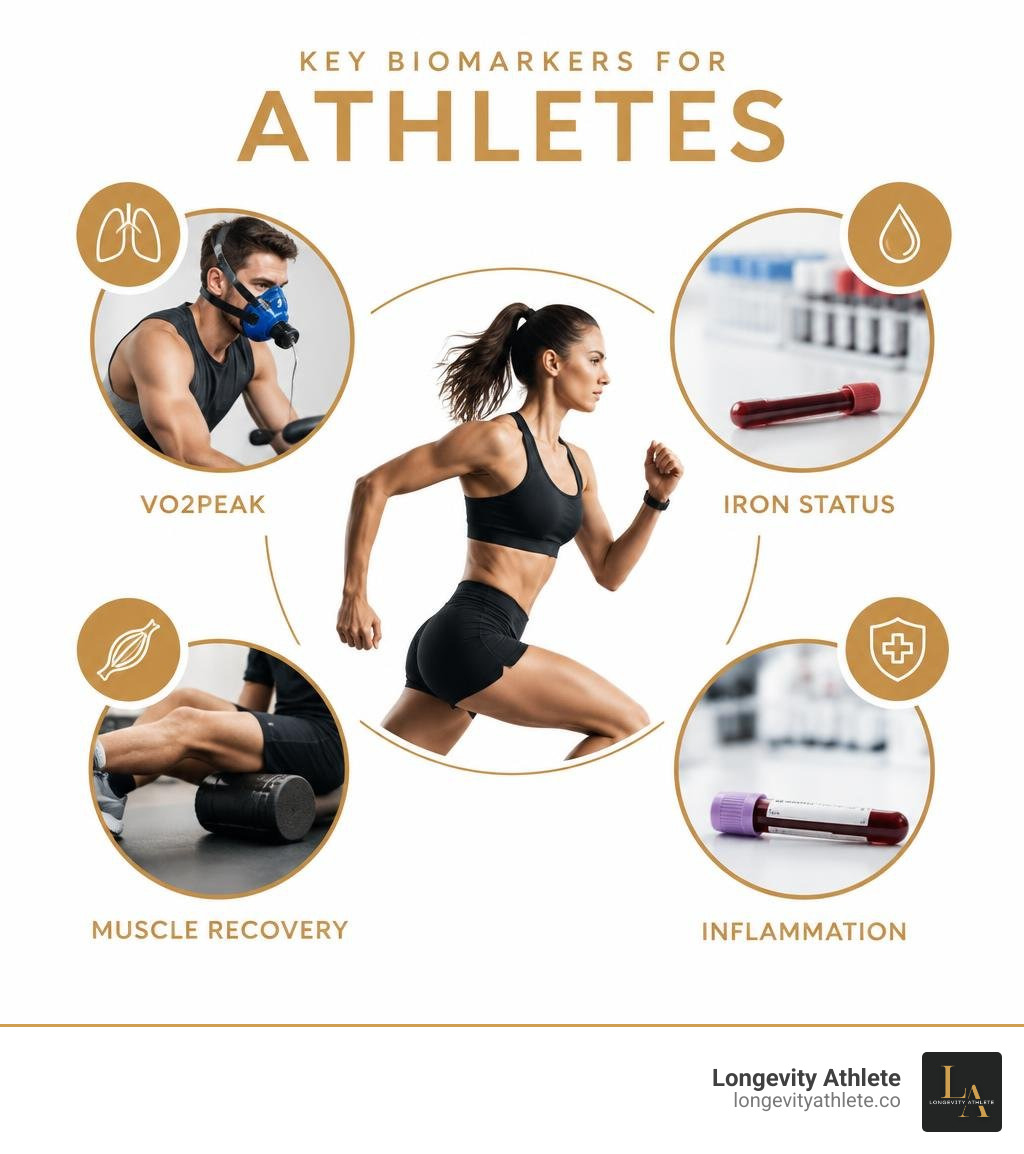
We classify markers into four interconnected categories:
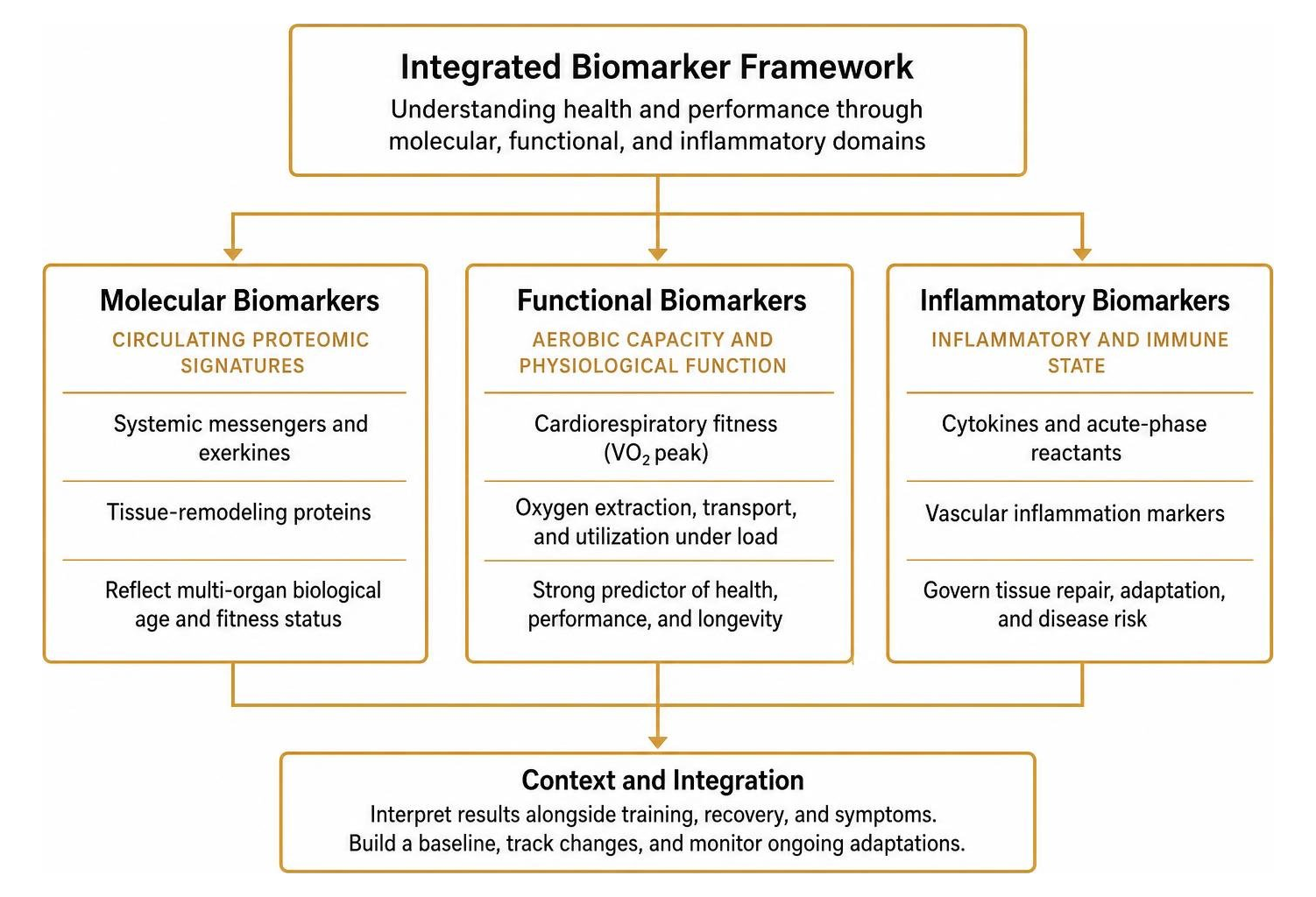
Functional Aerobic Capacity: How efficiently your cardiopulmonary system and mitochondria extract, transport, and utilize oxygen under load.
Circulating Proteomic Signatures: Systemic messengers, tissue-remodeling proteins, and exerkines that mirror multi-organ biological age and fitness status.
Muscle Integrity and Workload Stress: Direct cellular breakdown products and metabolic byproducts that indicate training strain, fatigue, and recovery readiness.
Systemic Inflammatory and Immune State: Cytokines, acute-phase reactants, and vascular inflammation markers that govern tissue repair, adaptation, and disease risk.
Understanding these biological dynamics allows us to establish clear reference baselines and monitor ongoing adaptations.
Cardiorespiratory Fitness as an Important Biomarker for Health and Performance
Cardiorespiratory fitness (CRF), quantified via peak oxygen uptake ($\text{VO}_2\text{peak}$) or $\text{VO}_2\text{max}$, is one of the single strongest clinical vital signs and independent predictors of all-cause mortality, cardiovascular longevity, and functional healthspan.
Traditional assessment demands gold-standard cardiopulmonary exercise testing (CPET) using metabolic carts and continuous gas exchange analysis during maximal treadmill or cycle ergometry. However, maximal CPET has real-world bottlenecks: high equipment costs, logistical friction, specialized operator requirements, and the sheer physical exhaustion required to push to failure. This makes frequent monitoring challenging for both competitive athletes and clinical populations.
Recent scientific breakthroughs reveal that fitness leaves a distinct molecular footprint in circulating blood. Landmark scientific research on proteomic fitness profiling across multi-thousand-participant cohorts demonstrated that blood proteomic signatures of CRF correlate strongly with measured treadmill performance and functional capacity. More impressively, each 1 standard deviation increase in a proteomic CRF score was associated with an unadjusted hazard ratio of 0.50 (95% CI 0.48–0.52) and an adjusted hazard ratio of 0.53 (95% CI 0.50–0.56) for all-cause mortality over a median follow-up of 13.7 years in the UK Biobank.
By monitoring key performance biomarkers, we bridge the gap between systemic cardiopulmonary health and actionable molecular adaptations.
Proteomic Profiles: An Important Biomarker for Health and Performance Tracking
Proteomics evaluates the vast library of circulating signaling molecules, structural peptides, and exerkines—biomolecules secreted by skeletal muscle, liver, and adipose tissue in response to exercise.
Using advanced high-throughput assays such as proximity extension assays (Olink) and nanoscale enzyme-linked immunosorbent assays (nELISA), researchers can quantify thousands of proteins from a single serum sample. A breakthrough study on multi-protein panels predictive of VO2peak published by the American Physiological Society evaluated young and older adults (ages 25–77) performing maximal incremental exercise. Using penalized linear regression models, a compact 10-protein serum panel explained 60% of the variance ($R^2 = 0.60$) in measured $\text{VO}_2\text{peak}$, achieving a correlation of $r = 0.78$ and a mean absolute percentage error (MAPE) of just 10%. In 69% of individuals (95% CI: 56–82%), predicted $\text{VO}_2\text{peak}$ fell within 5 ml/kg/min of actual CPET measurements.
Furthermore, broad epidemiological analyses utilizing LASSO regression compressed candidate libraries of over 7,200 proteins into an abbreviated 21-protein panel. This parsimonious signature maintained consistent predictive effect sizes for multisystem disease risk, cardiometabolic resilience, and mortality compared to full 307-protein panels ($\rho = 0.71$ correlation with measured CRF in derivation cohorts).
These panels encompass key biological pathways:
Metabolic regulation and insulin signaling: Proteins governing glucose uptake and lipid clearance.
Vascular and extracellular matrix remodeling: Factors regulating arterial compliance, angiogenesis, and collagen turnover.
Immune modulation and autophagy: Anti-inflammatory exerkines that suppress chronic low-grade inflammation.
Muscle Integrity, Recovery, and Systemic Inflammation Markers
While proteomic CRF scores reveal systemic aerobic architecture, daily workload management and recovery rely on established acute-phase biomarkers (Haller et al., 2023).
As highlighted in evidence-based athlete workload biomarker guidelines, monitoring muscular and systemic recovery requires a clear understanding of physiological timing and individual clearance:
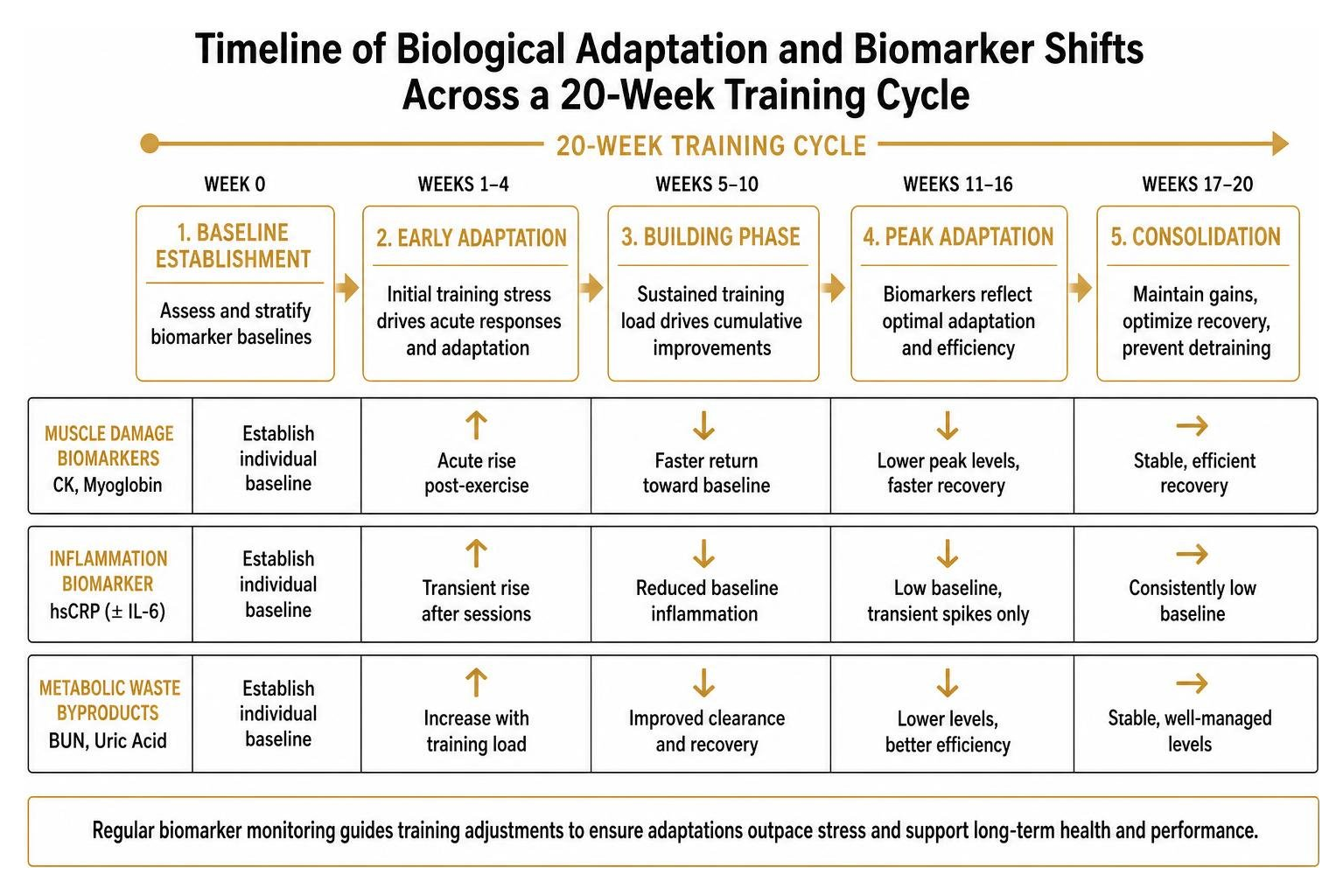
Creatine Kinase (CK) and Myoglobin: Intracellular muscle enzymes released into the bloodstream following mechanical microtrauma. Post-match soccer studies demonstrate CK elevations of up to 238%, while serum myoglobin can spike seven-fold after intense competitive bouts. Tracking CK baseline recovery prevents overreaching from deteriorating into chronic overtraining syndrome.
High-Sensitivity C-Reactive Protein (hsCRP): A primary hepatic acute-phase reactant. When evaluating inflammation blood markers, tracking hsCRP alongside cytokines like interleukin-6 (IL-6) helps differentiate healthy, transient post-exercise inflammatory signaling from systemic, non-resolving baseline inflammation.
Metabolic Waste Byproducts: Blood urea nitrogen (BUN) and uric acid reflect protein catabolism, glycogen depletion, and hydration status during high-volume training blocks.
Integrating regular inflammation testing into your routine ensures that training intensity never outpaces cellular recovery capacity.
Molecular Clocks vs. Fitness Biomarkers: Longevity Interventions
In human longevity research, biological age calculators are categorized into functional fitness metrics and molecular aging clocks.
An expert consensus framework on biomarkers of aging published in The Journals of Gerontology established consensus across 14 key biomarkers spanning physical function (gait speed, handgrip strength, timed-up-and-go), systemic physiology, and DNA methylation (DNAm) clocks. Concurrently, a foundational consensus review on longevity biomarkers in Cell outlined how epigenetic clocks and composite blood chemistries serve as responsive tools for clinical longevity trials.
Biomarker Domain | Primary Tool / Metric | What It Measures | Clinical Longevity Trial Evidence |
|---|---|---|---|
Epigenetic Aging Clock | GrimAge | DNA methylation patterns associated with plasma proteins and smoking history | In the DAMA trial, a plant-food-rich diet and exercise program induced a 0.66-year reduction in GrimAge acceleration. |
Pace of Aging | DunedinPACE | Speed of multi-system biological decline per chronological year | In the 2-year CALERIE trial, 12% caloric restriction significantly slowed DunedinPACE aging rate compared to controls. |
Blood Chemistry Age | PhenoAge | Multi-system clinical chemistry panel (albumin, creatinine, glucose, hsCRP, etc.) | Downward shift observed in the CALERIE trial, reflecting systemic metabolic and inflammatory rejuvenation. |
DNA Methylation Deviation | Horvath Clock | Multi-tissue pan-epigenetic methylation status | In the D-SUNNY trial, targeted vitamin D supplementation led to a 1.85-year decrease in Horvath age deviation. |
Proteomic CRF Panel | 21-Protein Fitness Score | Circulating exerkines, vascular, and metabolic signaling proteins | 1 s.d. increase provides a ~50% hazard reduction in all-cause mortality over 13.7-year follow-up (UK Biobank). |
While epigenetic clocks reflect cellular and molecular aging rates, proteomic fitness scores capture dynamic cardiorespiratory capacity, creating a complementary framework for assessing healthspan.
Clinical Applications and Training Adaptability
A central question in precision sports science is whether blood-based fitness biomarkers are fixed genetic traits or modifiable physiological signatures.
Data from the landmark HERITAGE Family Study answers this clearly. Following a standardized 20-week supervised endurance training program, participants exhibited significant, measurable increases in their proteomic CRF scores (paired t-test: $+0.14$; $95\%\text{ CI: } 0.11\text{–}0.18; P = 2.5 \times 10^{-15}$). This molecular shift correlated directly with actual measured gains in peak $\text{VO}_2$. A 1 s.d. increase in the recalibrated proteomic CRF score corresponded to a $0.84 \pm 0.25\text{ ml/kg/min}$ increase in measured $\text{VO}_2\text{peak}$, representing roughly 20% of the average training adaptation observed across the entire cohort.
Furthermore, proteomic fitness biomarkers provide powerful risk reclassification when paired with genetic Polygenic Risk Scores (PRS). In large-scale clinical cohorts, individuals with high genetic risk for coronary artery disease or type 2 diabetes who maintained high proteomic fitness scores exhibited disease hazard profiles comparable to or lower than genetically low-risk individuals with poor fitness. High cardiorespiratory fitness operates additively to offset inherited genetic vulnerabilities.
Applying this in practice involves structured testing protocols:
Baseline Stratification: Assessing comprehensive metabolic, inflammatory, and proteomic markers before initiating an intensity block.
Dynamic Protocol Adjustment: Integrating our biomarker training plan guide 2026 to calibrate training zones and recovery intervals.
Targeted Nutritional Fueling: Designing biomarker-based nutrition plans that address micronutrient deficiencies, glycemic control, and systemic inflammation.
Convenient Re-Testing: Utilizing strategies for how to test for inflammation at home via finger-prick dried blood spots between lab-based blood draws.
Frequently Asked Questions About Performance Biomarkers
How can a blood test estimate VO2peak without physical exercise?
A blood-based proteomic test measures circulating exerkines, metabolic enzymes, and vascular remodeling proteins that mirror cardiopulmonary function and mitochondrial density. Using validated machine learning and penalized linear regression models adjusted for age and sex, these circulating protein concentrations reliably estimate $\text{VO}_2\text{peak}$ with up to 60% explained variance and a 10% mean absolute percentage error, providing an accessible surrogate when maximal exercise testing is unavailable.
How do fitness biomarkers interact with genetic polygenic risk scores?
Fitness biomarkers and polygenic risk scores act additively. While your genome establishes baseline inherited susceptibility for conditions like atherosclerotic cardiovascular disease or insulin resistance, phenotypic fitness signatures reflect active biological defense mechanisms. Studies show that maintaining high cardiorespiratory fitness biomarkers significantly attenuates genetic disease predisposition, lowering real-world disease incidence.
Can baseline biomarkers predict responsiveness to training programs?
Yes. Pre-training levels of specific circulating proteins, baseline inflammatory cytokines, and metabolic markers explain why individuals show divergent adaptations to identical training loads. In the HERITAGE study, baseline proteomic profiles successfully predicted individual magnitude of $\text{VO}_2\text{peak}$ improvement prior to completing a 20-week cycling regimen. Identifying these profiles allows coaches and practitioners to optimize training volume, density, and recovery intervals.
Conclusion: Translating Biomarker Insights into Longevity
Cardiorespiratory fitness, proteomic profiles, and inflammatory markers represent the foundation of modern longevity medicine and precision athletic development. Moving beyond guesswork requires tracking objective biological data and refining lifestyle protocols over time.
At Longevity Athlete, we provide precision-performance wellness consulting for disciplined athletes, using personalized biomarker testing and data-driven protocols to optimize longevity and performance. The Signature Plan is a self-guided group program. The Gold and Platinum Plans create individualized lifestyle protocols.
To explore precision performance and longevity plans, visit Longevity Athlete and delve into our latest scientific insights on our blog.
References
Haller N, Behringer M, Reichel T, Wahl P, Simon P, Krüger K, Zimmer P, Stöggl T. "Blood-Based Biomarkers for Managing Workload in Athletes: Considerations and Recommendations for Evidence-Based Use of Established Biomarkers.." Sports medicine (Auckland, N.Z.), 2023. PMCID PMC10197055.