The Ultimate Guide to Becoming a Longevity Athlete
What Defines a Longevity Athlete? The Physiology of Lifelong Performance
At its core, athletic longevity is about maintaining functional capacity, metabolic resilience, and cardiovascular fitness across decades. Traditional fitness programs often focus entirely on short-term aesthetic changes or immediate race results. A longevity athlete, by contrast, views physiological health through the lens of biological age, systemic inflammation, and cellular vitality.
Cardiorespiratory fitness serves as the primary anchor of this approach. Decades of clinical research confirm that maximum aerobic capacity ($VO2\text{ max}$) is one of the strongest independent predictors of all-cause mortality and functional independence. As we age, $VO2\text{ max}$ naturally declines by roughly 10% per decade after middle age among sedentary populations. However, structured cardiovascular stimulus dramatically slows this trajectory.
Alongside cardiorespiratory power, metabolic efficiency—the ability of skeletal muscle to shuttle glucose, oxidize lipids, and clear metabolic byproducts—dictates how well your tissues perform under stress. When metabolic pathways operate smoothly, your body clears lactate efficiently, mitigates exercise-induced oxidative damage, and maintains steady cellular energy production.
Physiological Traits of an Elite Longevity Athlete
What separates individuals who experience rapid age-related decline from those who maintain elite physical output well into their 80s and 90s? The answer lies in measurable physiological markers.
Exceptional $VO_2\text{ Max}$ Benchmarks: While the average octogenarian male records a $VO2\text{ max}$ below 20 ml/kg/min, world-class masters endurance competitors achieve extraordinary marks. Juan López García recorded a laboratory-verified $VO2\text{ max}$ of 52.8 ml/kg/min at age 82. This value sits near the 70th percentile for healthy, active men in their 20s and 30s.
High Lean Tissue Mass: Maintaining skeletal muscle mass is vital for metabolic and mechanical stability. López García maintains 76.8% lean body tissue (mass exclusive of fat and bone), preventing the functional degradation typically associated with late-life sarcopenia.
Superior Muscle Oxygen Extraction: Peak performance in older age is heavily dictated by how efficiently working muscles extract and utilize oxygen delivered by the bloodstream. Studies highlighted in examinations of senior endurance physiology show that localized muscular oxygen extraction can remain remarkably youthful, even when maximal heart rate inevitably declines.
To understand where your own physiology stands and pinpoint specific areas for growth, exploring specialized biomarker tracking through our services provides the actionable data needed to build a sustainable athletic foundation.
Genetics vs. Lifestyle: Can Anyone Become a Longevity Athlete?
A common question is whether record-setting senior competitors are simply genetic outliers or if their outcomes can be approximated through consistent habits.
Genetics unquestionably establish the ceiling for extreme athletic performance, such as setting age-group world records. However, lifestyle choices, consistent training volume, and proactive recovery determine how close an individual gets to that ceiling. Epigenetic research shows that physical exercise actively influences gene expression, reducing chronic systemic inflammation and preserving cellular health.
Discipline consistently outperforms fleeting motivation. Athletes who thrive into their 80s and 90s do not rely on emotional enthusiasm to lace up their shoes; they rely on deeply ingrained daily routines. By prioritizing systematic recovery, balanced nutrition, and progressive overload, the average older adult can achieve physiological adaptations that dramatically alter their biological aging trajectory.
Case Studies: Real-World Lessons from Record-Breaking Octogenarians
Examining real-world case studies provides tangible proof of how the human body adapts to physical demands later in life.
Juan López García: From Late-Start Inactivity to Ultramarathon World Records
Juan López García’s journey illustrates that late-life beginnings do not preclude elite endurance capacity. A retired mechanic, López García was largely sedentary and could not sustain a continuous run for a full minute when he retired at age 66.
His progression began with long-distance walking, including completing the 500-mile Camino de Santiago trail. Transitioning gradually from walking to easy jogging intervals, he gave his connective tissues time to adapt to mechanical impact. Over the following decade and a half, his volume steadily expanded:
Weekly Mileage: Averaging roughly 40 miles per week during baseline maintenance, increasing to approximately 75 miles weekly during peak race preparation.
Annual Output: Regularly exceeding 2,175 annual running miles.
Competitive Milestones: In 2024, he secured the men's 80-to-84 title at the World Masters marathon championship in Bucharest with a time of 3:39:10. At age 82, he set a world age-group record for 31.1 miles (50 km) in 4 hours, 47 minutes, and 35 seconds, eclipsing the prior world mark by nearly 49 minutes.
López García’s success demonstrates that gradual, patient progression allows the cardiovascular and musculoskeletal systems to develop substantial aerobic capacity, even when starting from complete inactivity past age 60.
Emma Maria Mazzenga: Preserving Power and Sprint Mechanics in the 90s
While endurance running offers clear cardiovascular adaptations, master sprinting demonstrates how anaerobic power and neuromuscular speed can be maintained into one's tenth decade.

Italian sprinter Emma Maria Mazzenga, born in 1933, returned to competitive track at age 45 following a 15-year hiatus. Competing into her 90s, she holds world records in the 90-to-94 age category for the outdoor 200 meters (50.33 seconds) as well as the indoor 60-, 200- (54.47 seconds), and 400-meter events.
Scientific evaluations detailed in profiles of nonagenarian sprinting physiology demonstrate key neuromuscular insights:
Cellular Energy Production: Her muscle cell mitochondria exhibit respiratory capacities comparable to healthy individuals in their 20s.
Neuromuscular Integrity: Mazzenga’s motor neuron-to-muscle connections show minimal age-related degradation.
Fiber Adaptations: While fast-twitch fibers inevitably experience some age-related atrophy, her slow-twitch muscle fibers are unusually robust, well-developed, and capable of supporting high-intensity track repeats.
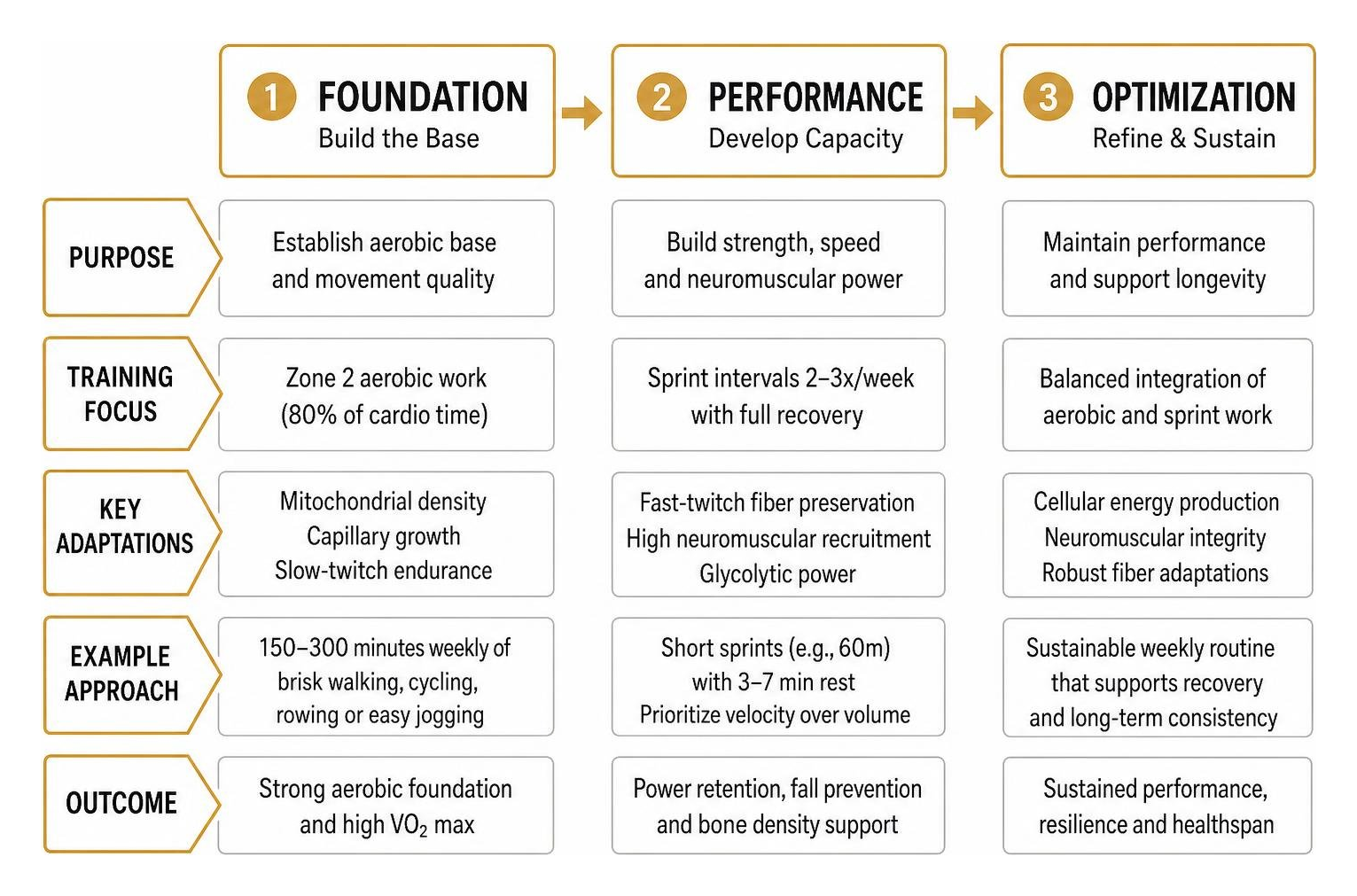
Her training protocol focuses on short, structured track sessions completed 2 to 3 times per week, featuring brief sprints (such as 60-meter intervals) followed by generous 3- to 7-minute rest periods to prioritize movement velocity and neuromuscular recovery over sheer volume.
Endurance vs. Sprint Training: Impact on Muscle Fibers and Longevity
Endurance exercise and sprint work drive distinct cellular adaptations. Understanding these mechanisms allows you to choose the right stimulus for your individual healthspan goals.
Training Parameter | Endurance Protocols (e.g., López García) | Sprint & Power Protocols (e.g., Mazzenga) |
|---|---|---|
Primary Muscle Fiber Target | Type I (Slow-Twitch) | Type IIa & IIx (Fast-Twitch) |
Cellular Adaptations | Enhanced capillary density & mitochondrial volume | High neuromuscular recruitment & glycolytic power |
Cardiovascular Impact | Left ventricular expansion & stroke volume growth | Rapid vascular elasticity & peak cardiac contractility |
Weekly Time Commitment | High (5–10+ hours weekly) | Low to Moderate (1–3 hours weekly) |
Longevity Benefit | Sustained aerobic base & high $VO_2\text{ max}$ | Fall prevention, bone density & power retention |
Endurance training increases mitochondrial density, capillary growth, and slow-twitch muscle endurance. Sprint and resistance training, conversely, help preserve Type II fast-twitch muscle fibers, which are often the first to atrophy as we age. Because losing fast-twitch fibers directly affects balance, explosive power, and reaction times, incorporating both modalities produces a well-rounded athletic profile.
Evaluating which training balance suits your current fitness level is straightforward when you review our transparent pricing structure to find the right level of support.
Practical Framework: How to Build Your Longevity Training Regimen
Becoming an enduring athlete requires a systematic approach that balances aerobic conditioning, resistance training, recovery, and smart nutrition.
Progressive Aerobic Base and Sprint Interval Protocols
Building an aerobic foundation requires consistency rather than excessive intensity.
Establish a Low-Intensity Aerobic Base (Zone 2): Dedicate 80% of your cardiovascular time to steady-state exercise where you can maintain a conversational pace. Aim to accumulate 150 to 300 minutes weekly through brisk walking, cycling, rowing, or easy jogging.
Transition Gradually: If you are transitioning from walking to running, use simple walk/jog intervals (e.g., 1 minute of jogging alternating with 2 minutes of walking) for several weeks before attempting continuous running. This gives tendons and ligaments time to adapt to impact forces.
Incorporate Short Sprint Intervals: Once a solid aerobic base is established, add 1 session per week of brief, high-intensity intervals (such as 10- to 20-second hill strides or stationary bike sprints) with 2 to 3 minutes of active recovery between reps. This stimulates fast-twitch muscle recruitment without placing excessive strain on joints.
Muscle Preservation, Nutrition, and Precision Protocols
Cardiovascular fitness must be balanced with targeted resistance work and nutrient timing to preserve lean tissue.

Skeletal Muscle Resistance Work: Train major compound movement patterns (squats, hinges, pushes, pulls, and carries) at least twice per week. Focus on controlled tempos, full ranges of motion, and progressive stimulus across various rep ranges to stimulate muscle protein synthesis and protect bone mineral density.
Targeted Protein Distribution: As we age, muscles develop anabolic resistance, requiring higher per-meal doses of essential amino acids to stimulate muscle repair. Aim for 1.2 to 1.8 grams of protein per kilogram of body weight daily, distributed across meals containing 30 to 40 grams of high-quality protein.
Anti-Inflammatory Nutritional Foundations: Center daily nutrition around whole foods, antioxidant-rich vegetables, lean proteins, complex carbohydrates, and healthy fats from sources like extra virgin olive oil, wild-caught fish, nuts, and seeds.
At Longevity Athlete, we tailor protocols to meet you where you are. The Signature Plan is a self-guided group program, while our Gold Membership and Platinum Membership create individualized lifestyle protocols designed to help you build strength, improve endurance, and sustain peak performance for years to come.
Frequently Asked Questions About Lifelong Athletic Performance
Is it ever too late to start training as a master athlete?
No. Research shows that skeletal muscle and cardiovascular systems retain plasticity well into advanced age. Adults who begin structured training past age 60 can achieve meaningful improvements in $VO_2\text{ max}$, insulin sensitivity, and functional strength. Because cardiovascular adaptations often occur faster than connective tissue remodeling, it is essential to increase training volume gradually and consult a qualified healthcare professional before beginning vigorous exercise after periods of inactivity.
How does sprint training benefit older adults differently than marathon training?
While marathon training emphasizes capillary density, mitochondrial volume, and continuous aerobic output, sprint training targets neuromuscular recruitment, fast-twitch (Type II) muscle fiber retention, and rapid force development. Sprint intervals also provide high cardiovascular stimulus in shorter sessions, making them an efficient way to support metabolic health and retain dynamic balance.
What baseline weekly activity is recommended for older beginners?
Older beginners should aim for a minimum of 150 minutes of moderate-intensity aerobic activity per week (such as brisk walking, swimming, or cycling). Complement this aerobic base with at least two weekly resistance training sessions targeting all major muscle groups, along with dedicated balance and mobility work. Always prioritize form, consistency, and recovery before increasing training intensity.
Conclusion
Athletic longevity is not about chasing short-term fitness trends—it is about cultivating a resilient, capable body that performs at a high level across every decade of life. By combining consistent aerobic conditioning, targeted resistance training, proper nutritional timing, and regular recovery, you can build a sustainable physical foundation.
The inspiring records of octogenarian and nonagenarian athletes show us what the human body can achieve when consistent effort meets sound physiological principles. With personalized biomarker tracking and continuous protocol refinement, you can systematically remove guesswork from your training and build lasting physical capacity.
Ready to take control of your healthspan and athletic future? Take the first step toward lifelong performance with Longevity Athlete today.