
The Definitive Guide to Key Performance Biomarkers
Why Performance Biomarkers Matter for Training and Recovery
Performance biomarkers are measurable signals in blood and other body fluids that help show how your body is responding to training. Used well, they can help you spot muscle strain, inflammation, fuel status, hydration issues, and recovery delays before they become obvious in performance or how you feel.
The most useful approach is not to chase one "perfect" number. Instead:
Build a personal baseline during a rested period.
Match each test to a clear question, such as "Am I recovered?" or "Was this session unusually stressful?"
Sample at consistent times and compare changes with training load, sleep, symptoms, and performance.
Use a small panel across several time points rather than an isolated test result.
For example, creatine kinase, myoglobin, C-reactive protein, and related chemistry markers can help identify delayed tissue strain. Cell-free DNA can rise within minutes of hard exercise, making it a promising rapid signal of acute load. Targeted metabolite panels may offer better detail on the recovery process over the following day or two.
For ultra-endurance athletes, pre-race profiles may also hold useful clues. In one 24-hour ultramarathon study, a combined panel that included hematocrit, lactate dehydrogenase, lipid measures, inflammatory cells, liver enzymes, homocysteine, and sodium was associated with distance covered. That does not make a blood test a race prediction machine. It shows why biological context can add value alongside fitness, pacing, nutrition, and race conditions.
The goal is simple: turn biological data into a better next decision. That means knowing which signal changed, why it may have changed, when it was measured, and whether it calls for normal training, adjusted recovery, or clinical follow-up.
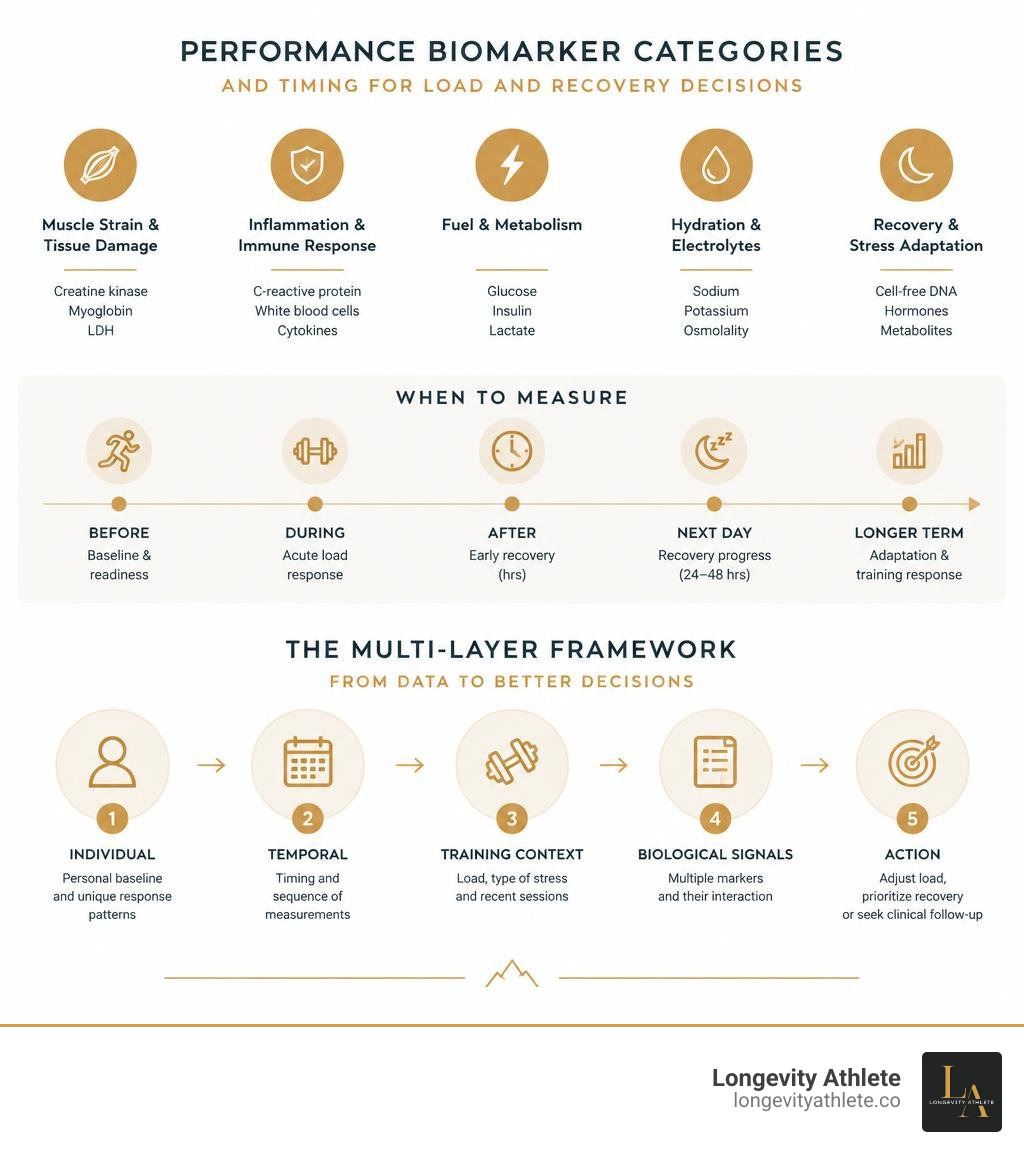
The Multi-Layer Framework for Tracking Performance Biomarkers
Tracking biological signals in sport is rarely as simple as measuring a compound and comparing it to a generic laboratory reference range. When we evaluate biological markers in competitive athletes, an isolated data point can be misleading if we do not know when the athlete trained, what type of stress was applied, or how their personal physiology typically responds.
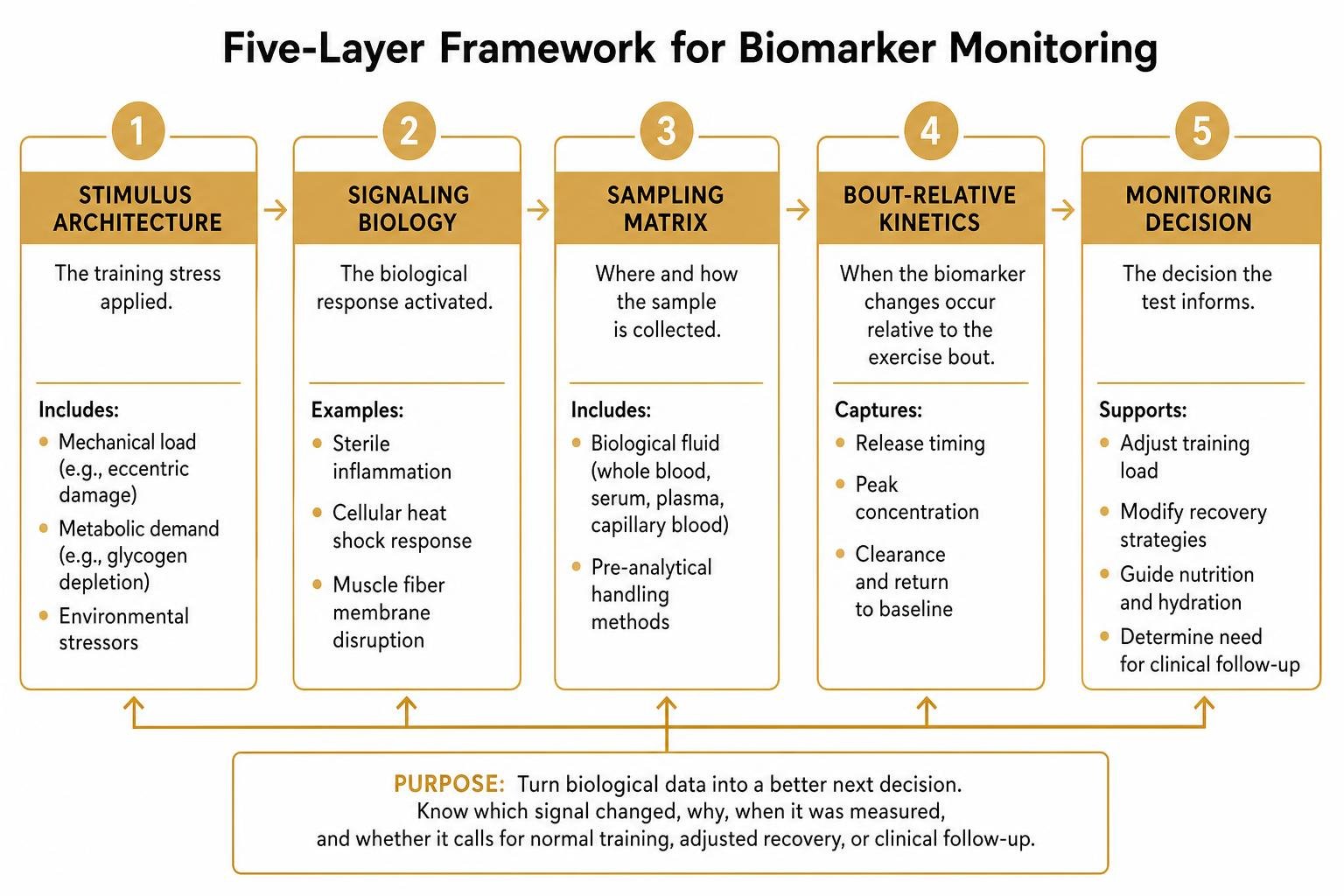
To turn raw biochemistry into actionable insight, scientific research on temporal biomarker frameworks emphasizes a structured, decision-linked model (Haller et al., 2023). Rather than viewing a blood test as a static snapshot, this multi-layer framework organizes data across five connected dimensions:
Stimulus Architecture: The specific mechanical, metabolic, and environmental demands of the training session (e.g., eccentric muscle damage versus prolonged glycogen depletion).
Signaling Biology: The biological pathway activated, such as sterile inflammation, cellular heat shock responses, or muscle fiber membrane disruption.
Sampling Matrix: The biological fluid evaluated (whole blood, serum, plasma, or capillary blood) and the pre-analytical handling methods applied.
Bout-Relative Kinetics: The precise timeline of analyte release, peak concentrations, and clearance rates relative to the exercise bout.
Monitoring Decision: The specific athletic choice the test supports, such as adjusting daily training volume, altering nutritional fueling, or scheduling extra rest.
When an athlete experiences severe physical overload, biological systems do not simply trip an on-off alarm. Instead, overload often presents as a progressive loss of signal resolution. In a well-recovered athlete, biomarkers rise predictably after hard exertion and return cleanly to baseline. In an overreached or under-recovered athlete, baseline levels drift, peak responses become blunted or erratically prolonged, and the body loses its distinct temporal signature.
To capture these dynamics without overwhelming athletes with daily venipunctures, we utilize sparse, staggered panels. By collecting targeted markers at carefully timed intervals—such as immediately post-session, at 2 hours, and at 24 hours—practitioners can map kinetic curves and differentiate between productive tissue remodeling and early physiological maladaptation.
Classical Chemistry vs. Molecular Signals in Load Monitoring
For decades, sports scientists have relied on classical clinical chemistry to track training stress. Markers such as creatine kinase (CK), blood lactate, serum urea, and myoglobin remain staples in high-performance environments. However, understanding their kinetics is critical to avoid misinterpreting normal training adaptations as pathology.
Creatine kinase serves as an established surrogate for muscle cell membrane permeability. Following heavy eccentric exercise or collision sports, CK activity can surge dramatically—often increasing by well over 200% within 24 to 48 hours. Yet CK clearance depends heavily on individual muscle mass, hydration, training history, and lymphatic clearance rates. Relying on CK alone cannot distinguish between healthy muscular adaptation and systemic fatigue (Haller et al., 2023).
Blood lactate thresholds reflect acute glycolytic flux and metabolic clearance capacity, while serum urea and blood urea nitrogen (BUN) provide insight into prolonged protein catabolism when glycogen stores run low. Myoglobin, by contrast, rises very rapidly following mechanical muscle damage and clears through the renal system within hours, making it an excellent marker for immediate structural strain rather than delayed fatigue.
As outlined in an evidence-based review on workload biomarkers, classical chemistry is highly effective for bounded monitoring tasks such as measuring delayed tissue strain and acute metabolic stress (Haller et al., 2023). For regular readers of our performance health insights, the consensus is clear: classical markers provide foundational context, but newer molecular signals are necessary to capture the full picture of cellular recovery.
Emerging Performance Biomarkers Across the Recovery-Overload Continuum
To look deeper into cellular stress before classic enzymes accumulate in the blood, sports medicine has turned toward emerging molecular targets. Among the most promising is circulating cell-free DNA (cfDNA). During vigorous exertion, activated neutrophils rapidly release extracellular traps containing cfDNA into the bloodstream within minutes. Because cfDNA peaks almost immediately and has a very short half-life, it offers unmatched temporal resolution for tracking acute mechanical and physiological load.
Similarly, heat shock proteins—specifically intracellular and extracellular HSP70—act as molecular chaperones that respond to thermal, metabolic, and oxidative stress. Circulating HSP70 concentrations rise in proportion to workout intensity and duration, and resting baseline shifts can indicate prolonged adaptation stress. Pro-inflammatory cytokines like interleukin-6 (IL-6) and enzymatic markers of leukocyte activation like myeloperoxidase (MPO) further characterize the systemic inflammatory response to hard training.
Biomarker Category | Key Analytes | Typical Kinetic Peak | Optimal Sampling Window | Primary Monitoring Decision |
|---|---|---|---|---|
Rapid Load Sensitivity | cfDNA, MPO | 0–60 minutes post-exercise | Immediately post-bout | Quantifying acute session stress; modifying same-day secondary sessions |
Delayed Tissue Strain | Creatine Kinase (CK), Myoglobin | 12–48 hours post-exercise | Next-morning fasting (24h post) | Assessing structural muscle breakdown; adjusting eccentric load |
Systemic Inflammation | IL-6, hs-CRP, HSP70 | 2–24 hours post-exercise | 12–24 hours post-exercise | Managing systemic inflammatory load and lifestyle recovery interventions |
Metabolic & Catabolic State | Urea, Free Amino Acids, Cortisol | 6–24 hours post-exercise | Waking rested baseline | Evaluating glycogen replenishment, protein synthesis, and fueling needs |
Predicting Endurance Capacity and Ultra-Endurance Load
Ultra-endurance events push metabolic and physiological resilience to extreme limits. In events like 24-hour ultramarathons, maintaining performance requires fine balance across hematological oxygen delivery, lipid metabolism, muscle membrane integrity, and electrolyte balance.
A groundbreaking study on pre-race serum biomarkers in ultramarathon runners demonstrated that baseline biochemical profiles collected just hours before a race can explain up to 78% of the variance in distance covered (adjusted $R^2 = 0.783$).

In this cohort of 50 ultra-endurance athletes, researchers identified several key pre-race performance relationships:
Positive Predictors of Race Distance: Higher pre-race hematocrit (HCT) supported aerobic capacity and peripheral oxygen delivery. Modestly higher baseline lactate dehydrogenase (LDH) reflected higher chronic training volumes. Optimized lipid profiles—specifically elevated total cholesterol, high HDL-to-LDL ratios, and functional circulating triglycerides—correlated with superior long-term energy availability and prolonged fatty acid oxidation.
Negative Predictors of Race Distance: Elevated baseline inflammatory and immune cell counts (monocytes and eosinophils) were associated with reduced distance, pointing to subclinical inflammation or incomplete taper recovery. Elevated liver enzymes (ALT, GGT) and elevated homocysteine signaled metabolic strain and hepatic stress, while higher baseline serum sodium levels negatively impacted long-term thermoregulation and hydration endurance.
Post-race analyses in 24-hour runners consistently reveal sharp declines in serum triglycerides, illustrating widespread mobilization and oxidation of free fatty acids to sustain energy production once glycogen stores are exhausted.
Cardiac and Vascular Stress Markers in Extreme Exertion
Prolonged high-intensity endurance bouts place considerable strain on the myocardium. Measuring cardiac-specific proteins helps distinguish normal exercise-induced physiological remodeling from subclinical injury.
High-sensitivity cardiac troponins (hs-cTnI and hs-cTnT) are the clinical gold standard for assessing myocardial membrane integrity (Zubair & Alsayouri, 2026). In healthy endurance athletes, transient increases in troponin and B-type natriuretic peptides (NT-proBNP) frequently occur following marathons and ultramarathons. Rather than signifying permanent ischemic necrosis, these elevations generally reflect reversible cardiomyocyte membrane blebbing, stretch-induced signaling, and temporary alterations in renal clearance (Zubair & Alsayouri, 2026).
As highlighted in the clinical reference on cardiac biomarkers, adjunctive markers like copeptin (a surrogate for vasopressin release during acute hemodynamic stress) and Heart-type Fatty Acid-Binding Protein (H-FABP) can detect myocardial strain within 1 to 4 hours of exertion (Zubair & Alsayouri, 2026). Serial delta measurements—tracking the percentage change across 24 to 48 hours—allow performance specialists to ensure these values normalize quickly.
When evaluating these cardiovascular signals alongside our specialized athletic performance services, context is paramount: a temporary spike after a 100-mile race that resolves within 48 hours is a normal physiological stress response, whereas persistent baseline elevations warrant formal clinical evaluation.
Multi-Omics and Machine Learning for Overreaching Detection
One of the greatest challenges in elite sport is distinguishing between functional overreaching (FOR)—a temporary, planned decline in performance that leads to positive supercompensation—and non-functional overreaching (NFOR), where excessive fatigue persists for weeks or months alongside biological maladaptation.
Because single analytes cannot capture the systemic nature of overtraining syndrome, sports science is moving rapidly toward multi-omics platforms that integrate genomics, transcriptomics, proteomics, and metabolomics.
In recent proteomic investigations, researchers identified nearly 600 unique serum proteins following multi-day extreme physical stress, with over 70 distinct proteins remaining significantly elevated throughout the recovery window. These proteomic shifts highlighted alterations in acute-phase signaling, complement cascades, and extracellular matrix remodeling.
By applying machine learning classification algorithms to targeted metabolomics and proteomics panels, sports scientists can uncover multi-parameter biosignatures. For instance, simultaneous drops in branched-chain amino acids, altered hypoxanthine-to-uric acid ratios, blunted nocturnal cortisol rhythms, and elevated resting inflammatory mediators form a distinct pattern. These biosignatures can flag early NFOR long before an athlete experiences chronic performance failure.
Circulating RNAs and Extracellular Vesicle Cargo
Beyond free-floating serum enzymes, circulating non-coding RNAs and extracellular vesicles (EVs)—including exosomes—provide unprecedented mechanistic insight into exercise recovery.
When skeletal muscle, vascular endothelium, and immune cells experience exercise stress, they package regulatory microRNAs (miRNAs), messenger RNAs, and signaling proteins into protective lipid-bilayer vesicles. These EVs enter the circulation and travel to distant tissues, coordinating systemic adaptations such as mitochondrial biogenesis, capillary angiogenesis, and localized muscle fiber repair.
While EV cargo profiling offers deep mechanistic depth, clinical and sports performance applications currently require strict analytical standardization. Isolating pure EV subpopulations requires rigorous size-exclusion chromatography and ultrafiltration to prevent contamination from abundant serum lipoproteins. Establishing standardized pre-analytical storage protocols is an ongoing focus in exercise immunology.
Genetic Polymorphisms and Training Load Prescription
An athlete's physiological response to training stress is partly shaped by their underlying genetic architecture. Targeted genetic profiling commonly examines polymorphisms in key regulatory genes:
ACTN3 (R577X): Encodes $\alpha$-actinin-3, a structural protein found exclusively in fast-twitch (Type II) muscle fibers. The 577R allele is strongly linked to explosive power, sprint capability, and greater mechanical force production, whereas the 577XX null genotype results in an absence of $\alpha$-actinin-3, favoring endurance efficiency and altered susceptibility to eccentric muscle damage.
PPARGC1A (Gly482Ser): Regulates peroxisome proliferator-activated receptor gamma coactivator 1-alpha ($PGC-1\alpha$), the master controller of mitochondrial biogenesis, oxidative phosphorylation, and capillary density.
COL5A1 (rs12722): Affects the $\alpha 1$ chain of type V collagen, influencing tendon stiffness, mechanical elasticity, running economy, and soft-tissue injury risk.
While genetic testing offers valuable baseline insights into tissue resilience and metabolic predisposition, it should never be used in isolation to prescribe training loads or select talent. Epigenetic modifications, training history, nutrition, and environmental factors exert profound regulatory control over gene expression. In elite sport, genetic data must be applied ethically as a probabilistic guide for injury prevention rather than a deterministic limit on athletic potential.
Methodological Challenges in Athlete Load Monitoring
Translating laboratory-grade biomarker science into daily athletic training involves navigating substantial methodological and statistical hurdles. Without strict quality control, pre-analytical variability can easily drown out real physiological signals.
Key methodological challenges include:
Pre-Analytical Consistency: Biomarker concentrations vary substantially depending on sampling matrix (serum versus EDTA plasma versus capillary finger-prick blood). For example, troponin I concentrations can measure up to 30% lower in plasma compared to serum. Inconsistent blood draw timing, postural changes, delayed centrifugation, or subtle sample hemolysis can distort results.
Circadian and Diurnal Fluctuations: Hormones like testosterone and cortisol follow steep diurnal curves, peaking in the early morning and dropping significantly by late afternoon. Biomarker tracking must occur at standardized times under identical fasting conditions.
Sex-Specific Hormonal Cycles: In female athletes, natural fluctuations of estrogen and progesterone across the follicular and luteal phases modulate substrate utilization, fluid retention, resting body temperature, and inflammatory cytokine responses. Reference baselines must be established relative to specific cycle phases or hormonal contraceptive use.
Point-of-Care (POC) Validation: While portable lateral flow devices and capillary testing units allow convenient field testing, many commercial devices lack rigorous validation against high-performance laboratory standards (e.g., LC-MS/MS or automated chemiluminescence analyzers).
Integrating Performance Biomarkers into Daily Load Management
To make biomarker monitoring truly actionable, data must integrate into an athlete's broader performance ecosystem. Biological markers should validate and inform external workload tracking (GPS metrics, power output, total volume) and subjective wellbeing indicators (perceived exertion, sleep quality questionnaires, muscle soreness ratings).
At Longevity Athlete, we build personalized reference baselines for our clients during rested training phases. Rather than relying on static population averages, we monitor an individual athlete's z-score deviations across specific microcycles. When an athlete's biomarker kinetics deviate from their personal norm, we refine their training volume, adjust macronutrient ratios, or modify recovery interventions.
Athletes looking to implement structured biomarker analysis into their training can explore our transparent pricing tiers or directly book a call with our performance consulting team.
Frequently Asked Questions About Athletic Biomarker Testing
How do pre-race blood biomarkers predict ultramarathon performance?
Pre-race biomarkers capture underlying physiological readiness, chronic training adaptations, and metabolic status before an event begins. Higher baseline hematocrit supports sustained aerobic capacity, balanced lipid ratios reflect robust fatty acid oxidation pathways, and low baseline inflammatory markers (monocytes, eosinophils) ensure the athlete is not entering extreme competition with unresolved systemic strain.
What makes cell-free DNA faster than creatine kinase for load monitoring?
Cell-free DNA (cfDNA) is released into circulation within minutes of intense muscular and metabolic stress via neutrophil extracellular traps. In contrast, creatine kinase (CK) is a large structural enzyme that slowly leaks across compromised muscle cell membranes, enters the circulation via lymphatic drainage, and typically peaks 24 to 48 hours post-exercise. This makes cfDNA superior for rapid, same-day session load tracking.
How do multi-omics panels distinguish functional from non-functional overreaching?
Multi-omics panels evaluate hundreds of biological variables across metabolic, endocrine, and immune domains simultaneously. Functional overreaching is characterized by acute, reversible biomarker spikes followed by a clean rebound to baseline. Non-functional overreaching exhibits systemic breakdown: chronic baseline elevation of inflammatory cytokines, persistent disruptions in amino acid metabolism, blunted endocrine output, and sustained alterations in recovery-phase protein expression.
Conclusion
Precision athlete monitoring is moving beyond guesswork and isolated laboratory tests. By treating biological markers as dynamic temporal signals within a decision-linked framework, disciplined athletes can optimize physical remodeling, prevent non-functional overreaching, and support long-term physiological resilience.
Every athlete requires a monitoring strategy tailored to their specific athletic goals, competitive schedule, and physiological profile. For self-directed athletes looking to master these concepts alongside peers, our Signature Plan is a self-guided group program. For competitors who require individualized lifestyle protocols, advanced biomarker tracking, and direct consultation, our Gold Membership and Platinum Membership create individualized lifestyle protocols to deliver fully customized, data-driven performance roadmaps.
Explore how precision performance wellness consulting can transform your training and longevity with Longevity Athlete.
References
Haller N, Reichel T, Zimmer P, Behringer M, Wahl P, Stöggl T, Krüger K, Simon P. "Blood-Based Biomarkers for Managing Workload in Athletes: Perspectives for Research on Emerging Biomarkers.." Sports medicine (Auckland, N.Z.), 2023. PMCID PMC10587296. Haller N, Behringer M, Reichel T, Wahl P, Simon P, Krüger K, Zimmer P, Stöggl T. "Blood-Based Biomarkers for Managing Workload in Athletes: Considerations and Recommendations for Evidence-Based Use of Established Biomarkers.." Sports medicine (Auckland, N.Z.), 2023. PMCID PMC10197055. Muhammad Zubair, Khalid Alsayouri. "Cardiac Biomarkers." StatPearls Publishing, 2026. NBK545216.